%20(3).png)


![TFD [LOGO] (10).png](https://static.wixstatic.com/media/bea252_c1775b2fb69c4411abe5f0d27e15b130~mv2.png/v1/crop/x_150,y_143,w_1221,h_1193/fill/w_179,h_176,al_c,q_85,usm_0.66_1.00_0.01,enc_avif,quality_auto/TFD%20%5BLOGO%5D%20(10).png)
66 Percent are Single by Choice, Nationwide Data Shows

For years, Valentine’s Day functioned as a quiet social deadline. If you were in a relationship, you celebrated. If you were single, you explained.


But new nationwide data from Agile Data Solutions Inc. suggest that this script is starting to loosen — and quickly.
According to survey findings gathered through Hustle PH, 68% of single respondents say they are single by choice. Not waiting. Not recovering. Not unlucky. Choosing.
Agile Data Solutions Inc. refers to this emerging pattern as “intentional singlehood” — a choice-driven shift where being single is framed as strategic and self-directed rather than transitional. In this framing, singlehood isn’t a waiting phase. It’s a deliberate position shaped by personal timing and priorities.
“The idea that everyone must be in a relationship by a certain age is slowly losing its hold,” said Jason Gaguan, chairman and co-founder of Agile Data Solutions Inc. “What we’re seeing is intentional singlehood — people choosing stability, growth, or peace before partnership.”

Singlehood as Strategy, Not Circumstance
Among singles, more than 40% say they are prioritizing personal, career, or financial goals, while 20% say they simply haven’t met the right person yet. The dominant story here isn’t delay — it’s sequencing.

Partnership is no longer treated as a prerequisite for adulthood. Instead, many respondents appear to be treating relationships as something that should align with their trajectory, not interrupt it.
This reframing is particularly significant in a culture where romantic milestones have traditionally carried strong social weight.
Valentine’s Day Still Loud — But Emotionally Quieter
Despite Valentine’s Day’s commercial and social intensity, emotional reactions are surprisingly subdued. The data show that 66% of respondents feel neutral as the holiday approaches.

At the same time, 64% agree that Valentine’s Day in the Philippines feels overly romanticized.
The contradiction is telling: Filipinos recognize the hype — but they’re less emotionally moved by it.

“Neutrality isn’t indifference,” Gaguan explained. “It suggests people are separating cultural messaging from personal worth.”
Rather than serving as a mirror for relationship status, Valentine’s is becoming just another seasonal moment — one that can be acknowledged without being internalized.
Pressure Has Not Disappeared — But It No Longer Dominates
There are still traces of social pressure. About 27% say they sometimes feel pushed to be in a relationship during Valentine’s Day. Among singles, 26% admit they occasionally feel left out.
But these are minority experiences.

More respondents — 39% — say they feel no pressure at all. A similar share of singles say they never feel excluded.
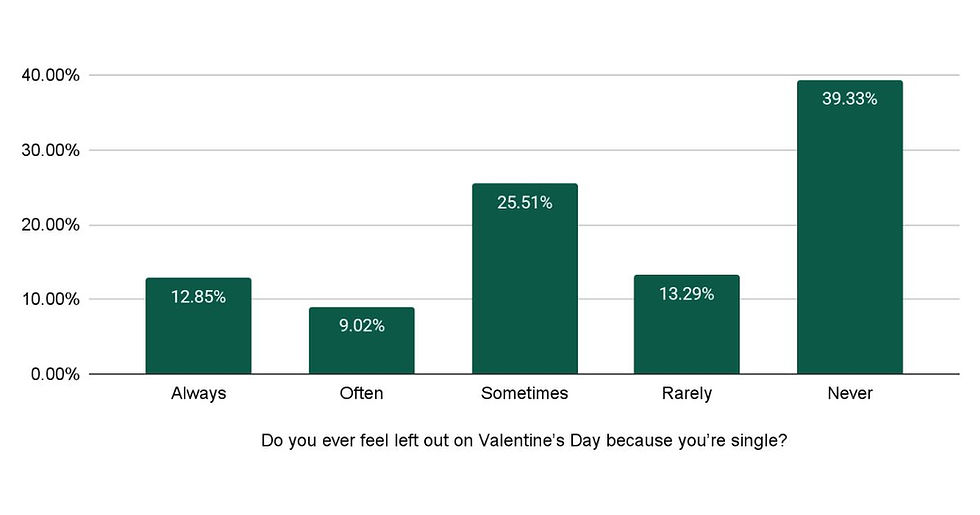
The emotional tone is no longer defined by longing or lack. It is defined by steadiness. Older respondents report even lower levels of pressure, suggesting that confidence in singlehood may strengthen over time.
Celebration Is Expanding Beyond Romance
If Valentine’s were still primarily about couples, celebration patterns would reflect that. Instead, they show diversification.

Thirty-two percent spend the day with family — slightly more than the 29% who celebrate with a romantic partner. Many others report relaxing or spending time casually.

More tellingly, 64% agree that Valentine’s Day today feels more about enjoyment than romance.
The holiday appears to be widening in meaning. Romance remains present — but no longer central.
Self-Love Is Intentional, Not Reactive
Emotional satisfaction, however, is high. Around 80% agree that spending on themselves makes them feel good, and more than 73% across relationship statuses report emotional returns from self-spending.
Among Gen Z singles, the most common motivations for self-spending are celebrating themselves (42%) and rewarding themselves for hard work or stress (29%).

This is not retail therapy driven by loneliness. It is structured self-recognition — a clear sign of “treat-onomics,” where small, intentional splurges function as emotional ROI and self-validation.
“Self-spending isn’t a substitute for romance,” Gaguan said. “It’s an expression of agency. People are choosing how to feel valued.”

A Subtle but Significant Cultural Shift
Taken together, the data point to something larger than Valentine’s trends.
Singlehood is no longer framed primarily as temporary or incomplete. Emotional neutrality has replaced urgency.
Celebration has broadened beyond romance. Spending has become modest but meaningful.

The most powerful insight may be this: when 68% say they are single by choice, Valentine’s Day stops functioning as a test. It becomes optional.
And in a culture that once tied February 14 closely to romantic validation, that shift may be one of the most telling signs of how modern Filipino priorities are evolving.


