%20(3).png)


![TFD [LOGO] (10).png](https://static.wixstatic.com/media/bea252_c1775b2fb69c4411abe5f0d27e15b130~mv2.png/v1/crop/x_150,y_143,w_1221,h_1193/fill/w_179,h_176,al_c,q_85,usm_0.66_1.00_0.01,enc_avif,quality_auto/TFD%20%5BLOGO%5D%20(10).png)
China is Poised to Wreck U.S. AI Industry
- By The Financial District

- Jan 2
- 2 min read
The math is simple. It starts with three facts. China has spent massive amounts to create very low-cost electricity at a pace several times faster than the United States.
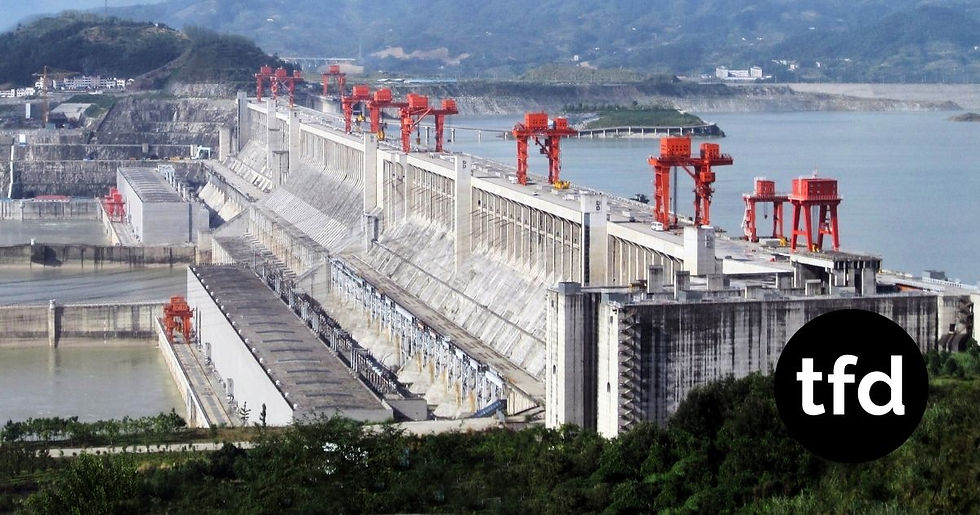


It has built enormous dams, the most prominent example being the Motuo Hydropower Station on the Yarlung Tsangpo River in Tibet.
No other nation could build such a colossal project so quickly, Douglas A. McIntyre reported for 24/7 Wall St.
China also has an extraordinary supply of solar power. Do major Chinese artificial intelligence (AI) companies pay for this? Largely, they do not — the government does.

There are three ways China is positioned to leap ahead in AI. While the U.S. faces major headwinds in building AI infrastructure, China is pursuing a centralized, state-driven approach reminiscent of America’s Manhattan Project.
Its top scientists are focused on a single goal: developing chips that rival those made by Nvidia Corp. Reuters has described the effort as China’s “Manhattan Project.”
Chinese researchers have reportedly built a prototype machine capable of producing cutting-edge semiconductor chips that power AI systems and advanced weapons — technology Washington has spent years trying to block.

The development is alleged to rely in part on technology taken from Western companies.
Finally, China is producing increasingly advanced AI models comparable to those of Alphabet Inc. and OpenAI and releasing them widely. Recent examples include DeepSeek-V3.2, available to the public, and DeepSeek-V3.2-Speciale, aimed at enterprise users.
Chen Fang, a Chinese engineer who worked on the project, said, “People thought DeepSeek gave a one-time breakthrough, but we came back much bigger,” according to VentureBeat.

While some skepticism remains, experts with access to the DeepSeek products say the advances appear genuine.
China can deploy vast numbers of top engineers without the intense competition for talent seen in the U.S., where companies routinely offer multimillion-dollar compensation packages. In China, such bidding wars are neither common nor permitted.


