%20(3).png)


![TFD [LOGO] (10).png](https://static.wixstatic.com/media/bea252_c1775b2fb69c4411abe5f0d27e15b130~mv2.png/v1/crop/x_150,y_143,w_1221,h_1193/fill/w_179,h_176,al_c,q_85,usm_0.66_1.00_0.01,enc_avif,quality_auto/TFD%20%5BLOGO%5D%20(10).png)
EXPENSIVE ROADS BUILT BY CHINA RAISE MONTENEGRO DEBT
- By The Financial District

- May 28, 2021
- 2 min read
Two sleek new roads vanish into mountain tunnels high above a sleepy Montenegrin village, the unlikely endpoint of a billion-dollar project bankrolled by China that is threatening to derail the tiny country's economy, Olivera Nikolic reported for Agence France Presse (AFP).
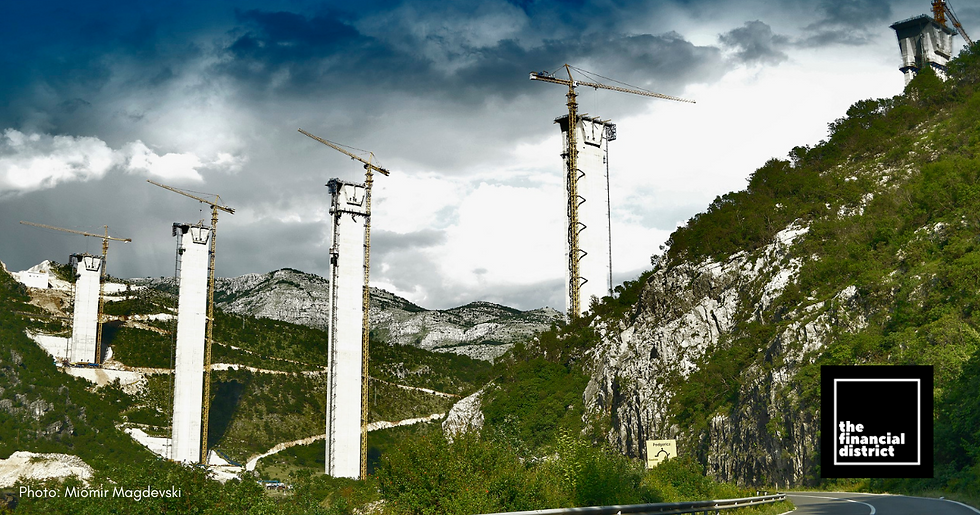

The government has already burned through $944 million in Chinese loans to complete the first stretch of road, just 41 kilometers (25 miles), making it among the world's most expensive pieces of tarmac.
Chinese workers have spent six years carving tunnels through solid rock and raising concrete pillars above gorges and canyons, but the road in effect goes nowhere. Almost 130 kilometers still needs to be built at a likely cost of at least one billion euros ($1.2 billion).
"The construction looks impressive, but we must not stop at this," says 67-year-old Dragan who retired to the village of Matesevo. "It's like buying an expensive car and just leaving it parked in the garage."

Critics question how the rest of the road will be paid for and highlight environmental damage to the river in Matesevo, a UNESCO World Heritage Site, caused by Chinese crews along with corruption allegations over the awarding of work contacts.
China has been widely criticized for saddling small countries with unmanageable debt as part of its global Belt and Road Initiative. Critics worry that it will use financial leverage to boost its political power, in what they dub "debt-trap diplomacy." They said China should stop this mantra of mutual benefit since the BRI is only for China, since all roads lead to Beijing.
Problems with the project were not unforeseen -- experts queued up a decade ago to tell the government that it was not viable. They warned that any benefits to commerce and tourism on the Adriatic, or development for poorer northern regions, would never outweigh the costs.
The current government has admitted revenue from tolls will not even cover the road's annual maintenance, estimated at 77 million euros ($94 million.) "It would take between 22,000 and 25,000 vehicles a day for the highway to pay off," civil engineer Ivan Kekovic told AFP, roughly four times the number he could envisage on the busiest stretch.

The section linking Matesevo to a town near the capital Podgorica -- the most difficult part to build -- is set to open in November. But the road is meant to connect the Adriatic port of Bar in the south with the Serbian border in the north, with the intention that the Serbians will then extend it to their capital, Belgrade.
It is unclear where the money will come from or how Montenegro -- a country with a GDP of 4.9 billion euros -- will repay its existing debt to China. If Montenegro cannot pay, it faces arbitration in Beijing and could be forced to give up control of key infrastructure, according to a copy of the contract seen by AFP.


