%20(3).png)


![TFD [LOGO] (10).png](https://static.wixstatic.com/media/bea252_c1775b2fb69c4411abe5f0d27e15b130~mv2.png/v1/crop/x_150,y_143,w_1221,h_1193/fill/w_179,h_176,al_c,q_85,usm_0.66_1.00_0.01,enc_avif,quality_auto/TFD%20%5BLOGO%5D%20(10).png)
50 Years of Diplomatic Relations Between Russia and the Philippines: Friendship Across the Ocean and Time
- Sergey Lavrov
- Jun 5
- 6 min read
On 2 June 1976, the Soviet Union and the Republic of the Philippines established diplomatic relations.
This step, the significance of which cannot be overestimated, was the deliberate choice of President Ferdinand Marcos Sr. to pursue an independent foreign policy regardless of the realities of the Cold War.


Half a century later, this day can be rightly called the starting point of the formation of mature and generally quite successful Russian-Philippine partnership based on mutual respect and consideration of mutual interests.
It is notable that the history of our relations is rooted deep in the past. Back in 1817, one official of the Russian Empire, Piotr Dobel, presciently envisioned this remote archipelago as a promising trading port in the Pacific Ocean and opened the first Russian consulate in Manila.
Decades later, Filipinos welcomed Russian travelers and sailors, including Vasily Golovnin, Fyodor Litke, Nikolay Miklukho-Maklai and Ivan Goncharov.
Travel notes of our outstanding compatriots introduced readers to the amazing culture of the island people.

The events of the Russo-Japanese War of 1904–1905 take a special place in the joint annals of our countries. It was the Manila Bay where the legendary cruiser Aurora found salvation after the tragic battle of Tsushima.
The Filipinos then showed genuine human compassion to the injured crew members that yet had unbroken spirit.
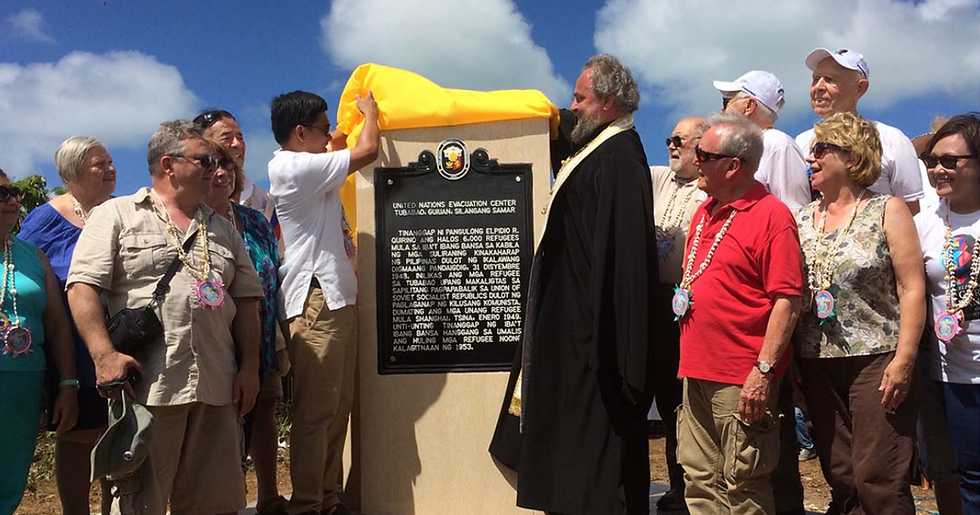
Another historical page relates to the middle of the last century when almost six thousand Russian refugees from China found temporary shelter on the island of Tubabao, where local residents kept the memory of the "White Russians", including the famous Saint John of Shanghai.
The common pages of history continue to serve as an important tool in developing our cooperation at the current stage.
The official visit of the President of the Philippines Rodrigo Duterte to Russia in May 2017, as well as his meetings with President Vladimir Putin at the platforms of the APEC forum and the Valdai International Discussion Club made a significant contribution to broadening cooperation.
Inter-parliamentary ties are also expanding. The meetings are held "on the sidelines" of the events of the Asia-Pacific Parliamentary Forum, the Assembly of the Inter-Parliamentary Union, and other multilateral associations.
The Philippine-Russian Parliamentary Friendship Group of the Senate of the Philippine Congress has been working productively.
Interregional exchanges are gaining momentum. Large-scale "Moscow Days" are regularly held in the Philippines; last time this was in May this year to mark the anniversary of the establishment of diplomatic relations.

The City of Cebu maintains twinning relations with the cities of St. Petersburg and Vladimir. Since 2024, there has been a cooperation program between Moscow and the City of Cebu. A similar document was signed with Manila this May.
Russia and the Philippines have a positive experience of military and technical interaction. In 2017, when ISIS-affiliated terrorist groups attacked the island of Mindanao, Russia provided the Philippines with Ural trucks and weapons for the Republic's army.
Since 2021, the ships of the Russian Pacific Fleet have made six friendly visits to Philippine harbors.

Practical cooperation projects are being carried out. Amid the aggravating situation in the world energy markets, at the request of Philippine partners, supply of Russian oil resumed this spring, while over 2.4 million barrels have already been shipped.
This step clearly demonstrates the Russian suppliers' reliability.
In September 2025, Moscow hosted the 4th meeting of the Joint Russian-Philippine Commission on Trade and Economic Cooperation. It outlined promising areas for joint efforts, including transport infrastructure, peaceful atom, space, information and communication technologies.
Rosatom State Corporation is working with Philippine partners on projects to construct small nuclear power plants, as well as the non-energy use of nuclear technologies in medicine, agriculture, and industry.

The spirit of partnership characteristic of bilateral relations manifested itself in 2013, when Russia provided humanitarian assistance to the Filipino people in dealing with the consequences of the devastating typhoon Haiyan, as well as during the COVID-19 pandemic when 20 million doses of the Russian Sputnik V vaccine were sent to the archipelago.
Cultural and educational ties foster an atmosphere of friendship and trust in relations between our peoples.
Russian audience fell in love with Philippine ballet thanks to Lisa Macuja-Elizalde, who studied at the Vaganova Ballet Academy. In 2023, the Moscow State Academical Dance Theatre "Gzhel" successfully performed in Manila.
Filipino students are studying in Russian universities, specializing in information technologies, nuclear energy, medicine and linguistics. In the 2025–2026 academic year, 34 Filipinos studied in Russia.

The Russian center in the Province of Cebu, which opened on 20 November 2025, is helping to strengthen mutual sympathy between citizens of our countries.
The center is gathering everyone interested in learning the language of Alexander Pushkin and Leo Tolstoy. In October 2025, a Russian language conference was held in Manila. We are delighted that it will be henceforth organized on an annual basis.
Our interfaith dialogue is advancing. The Russian Orthodox Church maintains contact with the Catholic Church in the Philippines. A new Orthodox church dedicated to the icon of the Mother of God Quick to Hearken was consecrated on 23 November 2025 on Panglao Island.

I would like to highlight the effective foreign policy coordination between our countries, particularly at the United Nations.
It is based on the unity or close alignment of our approaches to key challenges of our times and commitment to democratization of international relations based on the principles of the UN Charter in their entirety and interrelation.
We express our sincere gratitude to our Filipino partners for their co-sponsorship of the resolution titled "Eightieth anniversary of the end of the Second World War", submitted by Russia to the UN General Assembly. During the dark years of the war, our peoples bravely resisted the aggressors, fighting for the triumph of good and justice.
We are grateful to the Philippine authorities for their long-standing support of Russian resolutions aimed at combating the glorification of Nazism, strengthening trust in outer space activities, keeping outer space free from all kinds of weapons and preventing it from becoming a zone of geopolitical tensions.

We appreciate the principled position of the Philippines on the issue of neocolonialism.
We commend the Philippines for its support, alongside other countries of the World Majority, of the UN General Assembly Resolution proclaiming 14 December the International Day Against Colonialism in All Its Forms and Manifestations.
Russia notes with appreciation the balanced position taken by the Philippines' leadership on the settlement of the Ukrainian conflict and its understanding of the root causes of the conflict, that is, the infringement of Russia's fundamental security interests and violation of the rights of Russian and Russian-speaking population in Ukraine.
Russia opposes the militarization of the Asia-Pacific and rejects the expansion of military blocs threatening to undermine the central role of ASEAN in the regional security architecture.

We are convinced that the key to a peaceful development of the Asia-Pacific region, like that of other regions of the world, lies in the commitment to the principle of equal and indivisible security and development of broad cooperation based on equality.
Our country is guided by these very principles in its active efforts to strengthen the strategic partnership with ASEAN, chaired by the Philippines in 2026.
This year marks the 35th anniversary of the establishment of relations between Russia and the ASEAN. Both our countries take an active part in the work of joint mechanisms, including the Foreign Minister's Meeting and Economic Ministers' Meeting, Consultations of High Representatives for Security Issues, Dialogue on ICT Security-Related Issues and others.

I am pleased to note that our Filipino partners readily participate in our socio-cultural initiatives. In April last year, Filipino diplomats won nearly all awards at an online chess tournament among foreign ministries, the first in the history of Russia-ASEAN relations.
The Russia-ASEAN Summit, scheduled to take place in Kazan on 17–18 June, is set to become the centerpiece of the commemorative events dedicated to the anniversary of our relations.
We look forward to welcoming in Kazan the heads of all ASEAN member states, especially the President of the Philippines Ferdinand Romualdez Marcos Jr.

The forthcoming summit will allow us to consolidate the achievements of three and a half decades of cooperation between Russia and the ASEAN and outline an agenda for future mutually beneficial cooperation in such areas as trade, investments, energy, agriculture, digitalization, science, technology and innovation, education, tourism, cultural and humanitarian ties.
Together with our friends from Southeast Asia, we will strive to identify new promising directions for our joint endeavors.
In conclusion, I would like to congratulate all our friends in the Philippines on the 50th anniversary of our diplomatic relations. We are optimistic about the future and ready for new joint initiatives for the benefit of our citizens and in the interests of peace and prosperity.
--
ABOUT AUTHOR


