%20(3).png)


![TFD [LOGO] (10).png](https://static.wixstatic.com/media/bea252_c1775b2fb69c4411abe5f0d27e15b130~mv2.png/v1/crop/x_150,y_143,w_1221,h_1193/fill/w_179,h_176,al_c,q_85,usm_0.66_1.00_0.01,enc_avif,quality_auto/TFD%20%5BLOGO%5D%20(10).png)
Fragile Iraqi-Kurd Partnership Tries To Stop IS Revival
- By The Financial District

- Dec 18, 2021
- 2 min read
As a backhoe dug up the ground to build trenches, Iraqi soldiers scanned the vast farming tracts for militants; not far away, their Kurdish counterparts did the same.
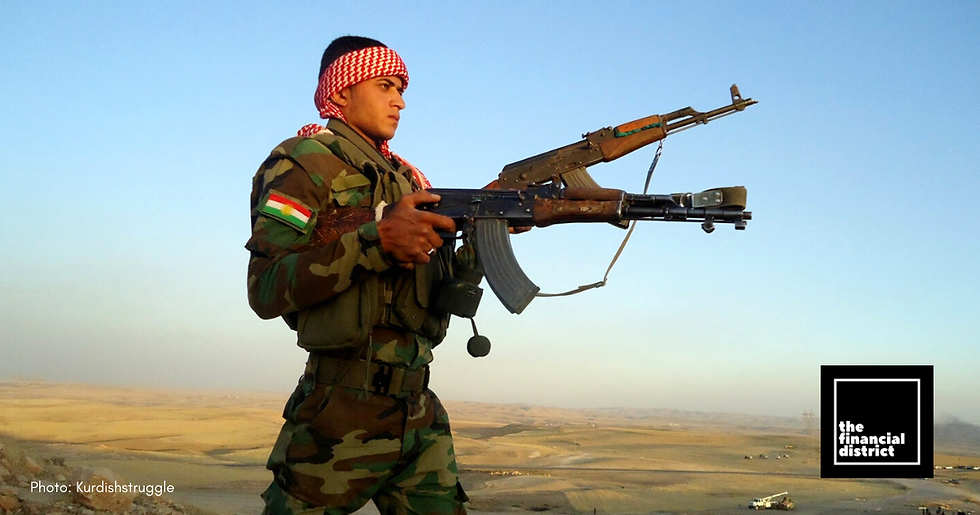
Photo Insert: Peshmerga Kurdish Army soldier


The scene earlier this month in the small northern Iraqi farming village of Lheiban was a rare instance of coordination between the federal government and the semi-autonomous Kurdish region.
The two sides were fortifying a joint position aimed at defending the village against attacks by the Islamic State group, Samya Kullab reported for the Associated Press (AP).

Despite a long-standing territorial dispute, Baghdad and Iraq’s Kurds are taking steps to work together to prevent a resurgence of the Islamic State group. Whether the fragile security partnership can hold is the big test in the next chapter of Iraq’s war with IS.
Both sides say they need the Americans to help keep it together — and they say that is one reason why the US military presence in Iraq is not going away even as its combat mission officially ends on Dec. 31.

Iraq declared IS defeated four years ago this month. But the rivalry between Baghdad and the Kurds opened up cracks through which IS crept back: a long, disputed zone snaking through four provinces -- Nineveh, Kirkuk, Salaheddin, and Diyala -- where the forces of either side did not enter.
In some places, the zone was up to 40 kilometers (24 miles) wide. Lheiban lies in one part of the zone, and a recent flurry of IS attacks threatened to empty the area of its residents, mostly Kurds.

So for the first time since 2014, Iraqi troops and peshmerga are setting up joint coordination centers around the zone to better police the gaps. “Daesh took advantage,” said Capt. Nakib Hajar, head of Kurdish peshmerga operations in the area, using the Arabic acronym for IS. Now, he said, “we are coordinating ... It begins here, in this village.”
On Dec. 7, peshmerga and Iraqi forces moved into the village with plans to replicate coordination elsewhere across the disputed territories. Kurdish officials hoped this would prompt villagers to return. Maintaining a Kurdish population in the area is key to their territorial claims.

The peshmerga have positions all along the ridge of the Qarachok mountains. But they don’t have orders to stop IS militants as they cross on attacks or to raid IS positions because of wariness over entering a disputed territory, explained Col. Kahar Jawhar.
Moreover, the militants move at night, using tunnels and hiding in caves, and the peshmerga lack key equipment including night vision. “That is why IS are able to terrorize the residents because we can’t see them,” Jawhar said.


