%20(3).png)


![TFD [LOGO] (10).png](https://static.wixstatic.com/media/bea252_c1775b2fb69c4411abe5f0d27e15b130~mv2.png/v1/crop/x_150,y_143,w_1221,h_1193/fill/w_179,h_176,al_c,q_85,usm_0.66_1.00_0.01,enc_avif,quality_auto/TFD%20%5BLOGO%5D%20(10).png)
Higher Salaries Spur Inflation-Denying U.S. Consumer Spending
- By The Financial District

- May 23, 2022
- 2 min read
With prices across the economy — from food, gas, and rent to cars, airfares, and hotel rooms — soaring at their fastest pace in decades, you might think Americans would tap the brakes on spending, Christopher Rugaber and Anne D’Innocenzio reported for the Associated Press (AP).
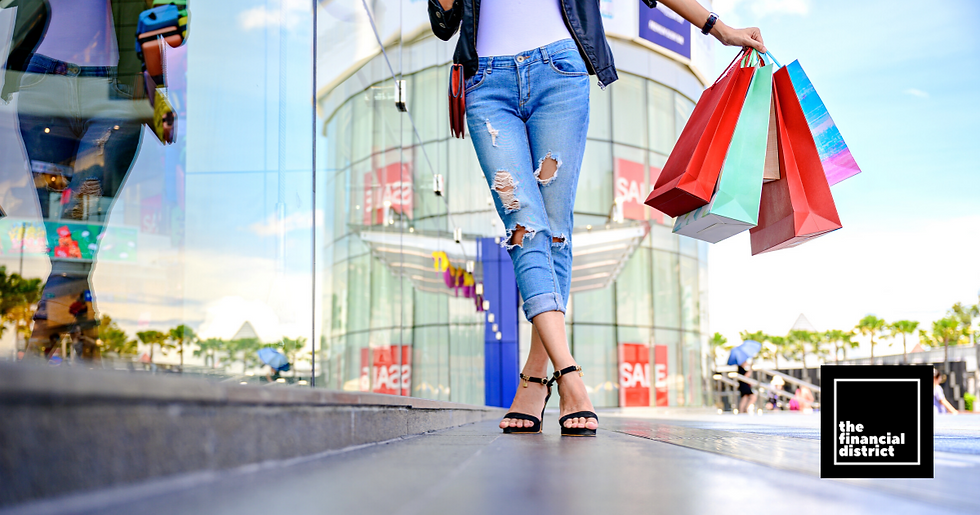
Photo Insert: There are those who warn that steady consumer spending won’t likely last in the face of the Fed’s aggressive credit tightening.


Not so far. Consumers as a whole are showing surprising resilience, not only sustaining their spending but increasing it even after adjusting for inflation. In April, the government said, retail sales outpaced inflation for a fourth straight month.
It was a reassuring sign that consumers — the primary drivers of America’s economy — are still providing vital support and helping allay concerns that a recession might be near.

Yet at the same time, there are signs that some people, especially in lower-income households, are starting to cut back, by shifting to lower-priced or alternative items or by skipping some purchases altogether as inflation shrinks their disposable income.
By most measures, consumers have downshifted from last year’s blowout spending, which was fueled by stimulus checks and other government aid after the brutal pandemic recession.

This year, noted Michelle Meyer, chief US economist at the MasterCard Economics Institute, steadily surging prices have dimmed Americans’ outlook for the economy.
Even so, Meyer said, there is some cause for optimism. “There’s still plenty of reasons to believe in the resilience of the consumer,” she said, pointing to America’s robust job market and the solid pay increases many people are receiving. “There is a certain amount of frustration as they navigate the environment we’re in. But they’re still spending.”

Consider that even while consumer sentiment as measured by the University of Michigan plunged nearly 30% over the past year, Americans’ spending outran inflation during that time. Economists at Michigan noted that there has been a “historic disconnect” between sentiment and actual consumer behavior.
Some economists warn that steady consumer spending won’t likely last in the face of the Fed’s aggressive credit tightening.

Earlier this month, in its quest to quell inflation, the Fed raised its benchmark rate by a half-percentage point and signaled additional large rate hikes to come. Some fear the economy could slide into recession next year. Still, several trends are driving Americans’ spending, including rising pay, savings amassed during the pandemic, and a rebound in credit card use.
Those savings and continued wage gains, economists say, could fuel healthy spending throughout this year.