%20(3).png)


![TFD [LOGO] (10).png](https://static.wixstatic.com/media/bea252_c1775b2fb69c4411abe5f0d27e15b130~mv2.png/v1/crop/x_150,y_143,w_1221,h_1193/fill/w_179,h_176,al_c,q_85,usm_0.66_1.00_0.01,enc_avif,quality_auto/TFD%20%5BLOGO%5D%20(10).png)
Joint Chiefs Chairman Calls GOP Afghan War A 'Strategic Failure'
- By The Financial District

- Sep 30, 2021
- 2 min read
The top US military officer called the 20-year war in Afghanistan a “strategic failure” and acknowledged to Congress on Tuesday that he had favored keeping several thousand troops in the country to prevent a collapse of the US-supported Kabul government and a rapid takeover by the Taliban, Robert Burns and Lolita C. Baldor reported for the Associated Press (AP).
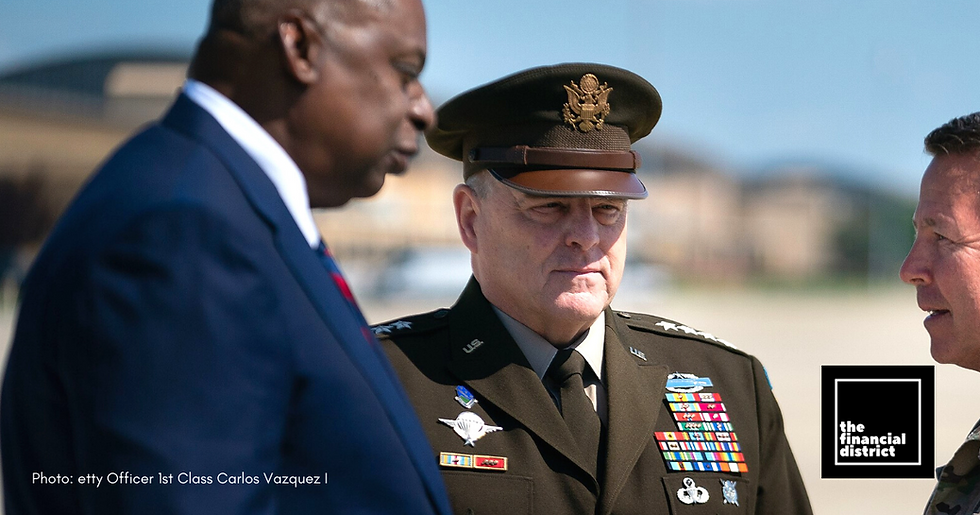
Photo Insert: Defense Secretary Lloyd Austin and Army Gen. Mark A. Milley, chairman of the Joint Chiefs of Staff, meet Army Gen. Scott Miller at Joint Base Andrews, Md., upon his return home from Afghanistan after relinquishing command of U.S. and NATO Resolute Support Mission, July 14, 2021.


Republicans on the Senate Armed Services Committee pointed to the testimony by Gen. Mark Milley, chairman of the Joint Chiefs of Staff, as evidence that President Joe Biden had been untruthful when, in a television interview last month, he suggested the military had not urged him to keep troops in Afghanistan.
Milley refused to say what advice he gave Biden last spring when Biden was considering whether to comply with an agreement the Trump administration had made with the Taliban to reduce the American troop presence to zero by May 2021, ending a US war that began in October 2001.

Testifying alongside Milley, Defense Secretary Lloyd Austin also refused to reveal his advice to Biden. The Trump deal with the Taliban, which did not involve the Afghan government, was described by resigned Trump national security adviser as a “surrender document.”
Milley told the committee, when pressed, that it had been his personal opinion that at least 2,500 US troops were needed to guard against a collapse of the Kabul government and a return to Taliban rule.

Defying US intelligence assessments, the Afghan government and its US-trained army collapsed in mid-August, allowing the Taliban, which had ruled the country from 1996 to 2001, to capture Kabul with what Milley described as a couple of hundred men on motorcycles, without a shot being fired.
That triggered a frantic US effort to evacuate American civilians, Afghan allies, and others from Kabul airport. Gen. Frank McKenzie, who as head of Central Command was overseeing US troops in Afghanistan, said he shared Milley’s view that keeping a residual force there could have kept the Kabul government intact.

“I recommended that we maintain 2,500 troops in Afghanistan, and I also recommended early in the fall of 2020 that we maintain 4,500 at that time, those were my personal views,” McKenzie said.
“I also had a view that the withdrawal of those forces would lead inevitably to the collapse of the Afghan military forces and eventually the Afghan government.”


