%20(3).png)


![TFD [LOGO] (10).png](https://static.wixstatic.com/media/bea252_c1775b2fb69c4411abe5f0d27e15b130~mv2.png/v1/crop/x_150,y_143,w_1221,h_1193/fill/w_179,h_176,al_c,q_85,usm_0.66_1.00_0.01,enc_avif,quality_auto/TFD%20%5BLOGO%5D%20(10).png)
Mikhail Gorbachev, Architect Of Soviet Union's Breakup, Dies At 91
- By The Financial District

- Aug 31, 2022
- 2 min read
Mikhail Gorbachev, the former Soviet leader whose reforms led to the break-up of his own country and the demise of communism across central and eastern Europe, has died in Moscow aged 91, Andrew Roth and Luke Harding reported for The Guardian.
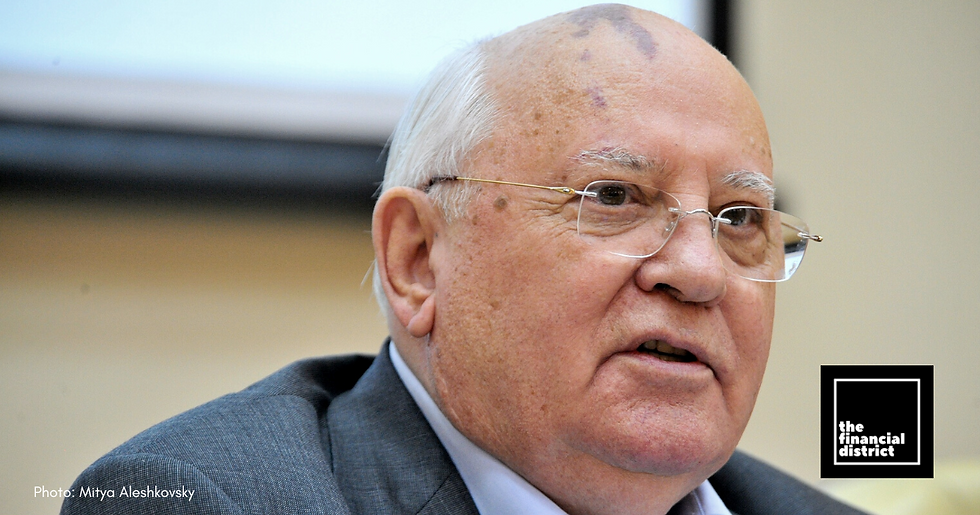
Photo Insert: A quarter-century after the collapse, Gorbachev told AP that he had not considered using widespread force to try to keep the USSR together because he feared chaos in the nuclear country.


US President Joe Biden called Gorbachev a “man of remarkable vision” and a “rare leader” who had “the imagination to see that a different future was possible and the courage to risk his entire career to achieve it. The result was a safer world and greater freedom for millions of people,” Biden said in a statement.
“Hard to think of a single person who altered the course of history more in a positive direction" than Gorbachev, said Michael McFaul, a political analyst and former US ambassador in Moscow, on Twitter.

“Gorbachev was an idealist who believed in the power of ideas and individuals. We should learn from his legacy,” Jim Heintz reported for the Associated Press (AP).
Gorbachev's decline was humiliating. His power hopelessly sapped by an attempted coup against him in August 1991, he spent his last months in office watching republic after republic declare independence until he resigned on Dec. 25, 1991. The Soviet Union wrote itself into oblivion a day later.

A quarter-century after the collapse, Gorbachev told AP that he had not considered using widespread force to try to keep the USSR together because he feared chaos in the nuclear country.
“The country was loaded to the brim with weapons. And it would have immediately pushed the country into a civil war,” he said. Gorbachev, who won the Nobel peace prize in 1990, had died after a “difficult and protracted illness”, Russian news agencies cited hospital officials as saying on Tuesday.

Recent reports suggested he was suffering from a kidney ailment, Vladimir Isachenkov and former AP news director Kate de Pury also reported for AP.
After visiting Gorbachev in hospital on 30 June, the liberal economist Ruslan Grinberg told the armed forces news outlet Zvezda: “He gave us all freedom – but we don’t know what to do with it.”

Alexei Kudrin, a liberal Russian politician who has remained in government, said that Gorbachev’s ideas had “given the country and the whole world a new breath.” Gorbachev took a dim view of Putin’s slow, systematic squashing of civil society.
In several notable speeches, he accused the Russian President of turning the United Russia party into a bad copy of the Communist Party, and of blatant authoritarianism. “He thinks that democracy stands in his way,” Gorbachev said of Putin in 2010.

For its part, Russia’s state media has cast Gorbachev in the role of enemy. It has variously portrayed him as a CIA stooge and the man responsible for the Soviet Union’s collapse – “the greatest political catastrophe of the 20th century,” as Putin put it. Mostly, it has ignored him.