%20(3).png)


![TFD [LOGO] (10).png](https://static.wixstatic.com/media/bea252_c1775b2fb69c4411abe5f0d27e15b130~mv2.png/v1/crop/x_150,y_143,w_1221,h_1193/fill/w_179,h_176,al_c,q_85,usm_0.66_1.00_0.01,enc_avif,quality_auto/TFD%20%5BLOGO%5D%20(10).png)
Listening in Real Time: What Philippine Airports Can Learn from the World’s Largest Operators
- By The Financial District

- May 24
- 5 min read
Updated: May 25
For decades, the Philippine airport experience carried with it a certain reputation.
Long queues, aging terminals, inconsistent amenities, traffic-clogged access roads, and unpredictable passenger flow became part of the accepted rhythm of domestic and international travel.



For many Filipinos, airports were not symbols of national pride but pressure points of frustration.
That narrative is now beginning to change.
Across the country, the Philippine aviation sector is undergoing one of the most consequential transformations in its modern history. Driven by privatization, infrastructure modernization, and aggressive technology adoption, airports are no longer being viewed merely as transport facilities.

They are increasingly being treated as customer experience ecosystems.
The shift comes at a critical moment. The Philippines is now considered one of the world’s fastest-growing aviation markets, with passenger volumes rebounding sharply after the pandemic years.
Ninoy Aquino International Airport (NAIA) alone processed a record 4.96 million passengers in January 2026, underscoring both the urgency and the opportunity confronting the industry.

Yet while infrastructure spending often dominates headlines, the next frontier in aviation competitiveness may ultimately depend on something less visible but far more strategic: understanding how passengers actually feel in real time.
That is where global airport operators like AENA and daa offer a compelling blueprint for the Philippines.
Both operators, among the most sophisticated airport managers in the world, have quietly transformed passenger experience management using the HappyOrNot real-time feedback platform.
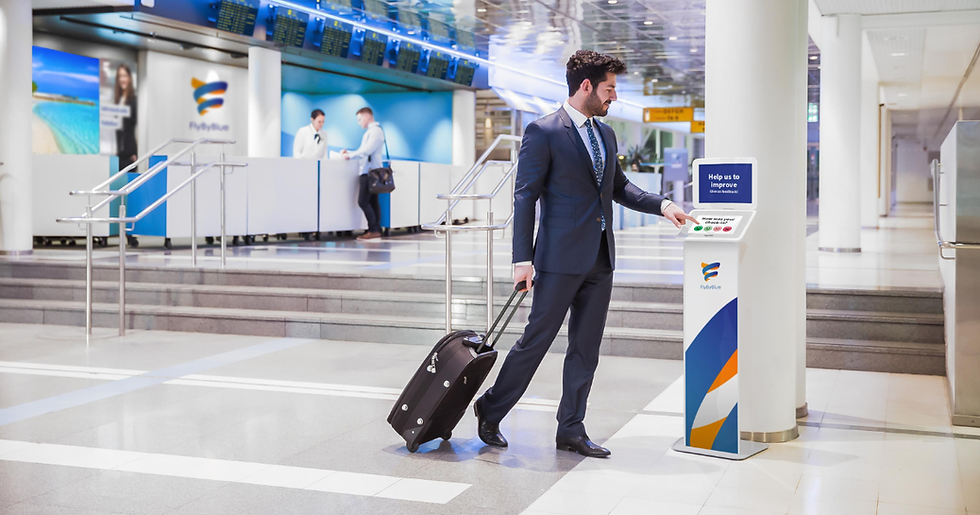
Their experience suggests that the future of airport modernization is not simply about building bigger terminals, but about creating feedback-driven operational cultures capable of responding to passenger sentiment minute by minute.
The timing could not be more relevant for the Philippines.
The Department of Transportation’s ongoing pivot toward public-private partnerships is rapidly reshaping the country’s airport landscape.
New NAIA Infrastructure Corp., led by San Miguel Corporation, has committed ₱170.6 billion toward modernizing NAIA over the next two decades.

Passenger capacity is expected to nearly double from 35 million to 62 million annually.
Meanwhile, Luzon International Premier Airport Development (LIPAD) Corporation has helped position Clark International Airport as the country’s benchmark for modern airport operations, emphasizing contactless processing, smoother passenger flow, and improved terminal comfort.
The government also plans to privatize at least 15 more regional airports before the end of 2026, while large-scale projects like the New Manila International Airport continue moving toward realization.

Visible improvements are already emerging.
Self-check-in kiosks are reducing dependence on traditional counters. Biometric e-gates are accelerating immigration processing. Dedicated ride-hailing bays are streamlining arrivals.
Terminal reassignments are helping decongest overcrowded facilities. Food halls, stronger Wi-Fi infrastructure, improved air conditioning systems, and upgraded restrooms are gradually reshaping traveler perceptions.

Still, infrastructure alone does not guarantee a better passenger experience.
A sparkling terminal can still produce unhappy passengers if restroom maintenance lags during peak hours, if queue congestion spikes unexpectedly, or if staff deployment fails to match traffic surges.
In modern aviation, operational responsiveness matters just as much as architectural investment.

“Modern airports can no longer rely purely on infrastructure upgrades alone. Passenger expectations today are dynamic, emotional, and highly time-sensitive,” says Enrico G. Urbina, Group Brand Manager at G.U.L.F. Trading Wireless Solutions, the company which serves as the authorized Philippine and Southeast Asian reseller of the HappyOrNot real-time feedback platform.
“What separates leading global airport operators now is their ability to listen to passengers in real time, identify friction points as they happen, and empower frontline teams to respond immediately. In many ways, real-time feedback has become just as important as runway capacity or terminal expansion because it directly shapes how travelers remember the airport experience,” Urbina emphasizes.

This is precisely where operators like AENA have gained an edge.
As the world’s largest airport operator, AENA manages 45 airports in Spain and oversees another 23 airports internationally. Across its network, the company has rolled out roughly 1,000 HappyOrNot feedback terminals, collecting more than 50 million passenger responses.
The value of the system lies not merely in gathering opinions, but in converting passenger sentiment into operational intelligence.

Passengers can instantly rate areas such as security screening, baggage claim, restroom cleanliness, commercial zones, parking facilities, and lounges.
That data is then cross-referenced against passenger volume and operational metrics, allowing airport teams to identify friction points in real time.
If satisfaction scores suddenly dip in a restroom cluster or security zone, teams can immediately investigate, dispatch cleaning crews, adjust staffing levels, or recalibrate workflows before issues escalate.
Importantly, AENA has integrated passenger satisfaction directly into its management KPIs. In effect, passenger sentiment became measurable operational currency.

The same philosophy has been embraced by daa, operator of Dublin and Cork airports in Ireland.
Unlike traditional quarterly satisfaction surveys, daa now receives continuous streams of passenger feedback across security checkpoints, washrooms, boarding gates, lounges, retail zones, and food-and-beverage areas.
The organization gathers approximately 2.25 million passenger responses annually. What emerged from the data proved revealing. The airport operator discovered that satisfaction scores tended to weaken during staff breaks and shift transitions.

Certain low-capacity washrooms consistently generated lower scores during heavy passenger periods. Some operational pain points varied sharply by terminal zone and demographic group.
Rather than relying on assumptions, airport management gained precise visibility into the passenger journey.
The results became tangible. daa reported a three-point improvement in washroom Net Promoter Scores, an 80% reduction in service-quality-related fines, and a 22-place climb in Ireland’s Most Reputable Companies rankings in 2024.

Equally important, the system helped cultivate organizational accountability. Frontline teams could now see how their actions directly influenced passenger perception.
For Philippine airports, the implications are significant.
As privatization accelerates, operators will increasingly compete not just on infrastructure scale but on consistency of experience. The airports that succeed will likely be those capable of transforming passenger feedback into operational decision-making.
This matters because modern airports have evolved into economic ecosystems.

Passenger satisfaction directly influences retail spending, tourism perception, airline partnerships, and even investor confidence. According to Airports Council International research cited by daa, a one-percent rise in passenger satisfaction correlates with a 1.5% increase in retail and food-and-beverage spending.
In a country where tourism remains a strategic economic pillar, that relationship cannot be ignored.
The Philippine aviation sector is already investing heavily in physical modernization.

The next challenge is ensuring that these investments remain responsive to the people actually moving through the terminals every day. That may ultimately be the deeper lesson from AENA and daa.
The future of aviation is no longer simply about moving passengers efficiently from Point A to Point B. It is about understanding the emotional texture of the journey itself.
And in an industry where millions of travelers pass through terminals annually, sometimes the most valuable infrastructure investment is not another concrete expansion, but the ability to listen in real time.
--


