%20(3).png)


![TFD [LOGO] (10).png](https://static.wixstatic.com/media/bea252_c1775b2fb69c4411abe5f0d27e15b130~mv2.png/v1/crop/x_150,y_143,w_1221,h_1193/fill/w_179,h_176,al_c,q_85,usm_0.66_1.00_0.01,enc_avif,quality_auto/TFD%20%5BLOGO%5D%20(10).png)
Russia's Mercenary Wagner Group Earns Windfall In Africa
- By The Financial District

- Feb 11, 2022
- 2 min read
Russia is intensifying its competition with the United States in Africa. In its asymmetric race, Russia uses nominally private, but in fact state-linked actors such as the private security company the Wagner Group and the infamous St. Petersburg “troll farm” the Internet Research Agency (IRA).
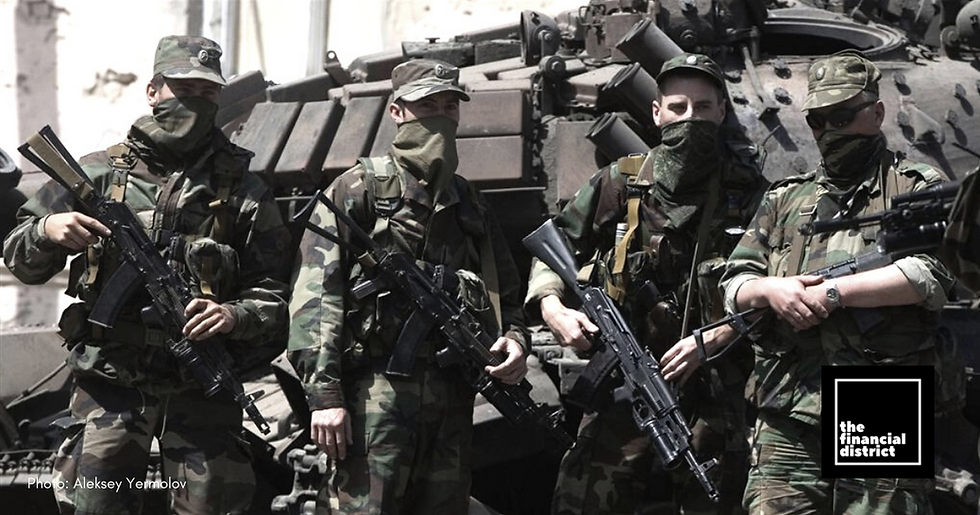
Photo Insert: Mercenary groups are usually composed of former special forces soldiers.


Both are a major threat to democracy and rule of law in Africa and beyond, Federica Saini Fasanotti, a nonresident senior fellow at the Brookings Institution wrote.
In its African strategy, the Kremlin is motivated foremost by a desire to thwart US policy objectives, almost irrespective of their substance. Considering Africa “one of Russia’s foreign policy priorities,” Russian President Vladimir Putin also seeks to create African dependencies on Moscow’s military assets and access African resources, targeting countries that have fragile governments but are often rich in important raw materials, such as oil, gold, diamonds, uranium, and manganese.

Russian private security companies like the Wagner Group purport to redress complex local conflicts with which African governments have struggled. They also offer them the ability to conduct counterinsurgency and counterterrorism operations unconstrained by human rights responsibilities, unlike the US, allowing African governments to be as brutish in their military efforts as they like.
In turn, Russia seeks payment in concessions for natural resources, substantial commercial contracts, or access to strategic locations, such as airbases or ports. Since 2006, Putin has sought to rebuild Russia’s presence and role in Africa significantly weakened after the collapse of the Soviet Union in 1991.

Between 2015 and 2019, Moscow signed 19 military collaboration agreements with African governments. The collaboration has focused in large part on Russian weapons sales.
More importantly, however, the expansion of Russia’s influence in Africa has centered on the use of private security companies to deliver counterinsurgency and counterterrorism training and advising to local governments struggling to counter militancy.

The expansion of their presence across the continent is taking place despite the fact that since March 2018, Russia has outlawed mercenaries under Article 359 of its criminal code. Beyond avoiding official Russian military casualties and thus public outcry against and supervision of deployments abroad, the private security contractors provide plausible deniability for the Kremlin.
Moscow disavows any command and control over them to absolve itself of their problematic behavior, such as egregious human rights violations and abuse of civilians. They also provide a proxy tool for military confrontations with the US without directly implicating Russian troops.

In 2018, some 300 Wagner Group contractors, for example, clashed with US special operations forces in Deir el-Zour, Syria, wiping out the entire Russian force. Beyond propping up governments aligned with Moscow, the Russian contractors are also a source of intelligence for the Kremlin.


