%20(3).png)


![TFD [LOGO] (10).png](https://static.wixstatic.com/media/bea252_c1775b2fb69c4411abe5f0d27e15b130~mv2.png/v1/crop/x_150,y_143,w_1221,h_1193/fill/w_179,h_176,al_c,q_85,usm_0.66_1.00_0.01,enc_avif,quality_auto/TFD%20%5BLOGO%5D%20(10).png)
Russia's Ruble Rebounds; Analysts Assess Impact Of Sanctions
- By The Financial District

- Mar 31, 2022
- 2 min read
The ruble is no longer rubble. The Russian ruble by Wednesday had bounced back from the fall it took after the US and European allies moved to bury the Russian economy under thousands of new sanctions over its invasion of Ukraine.
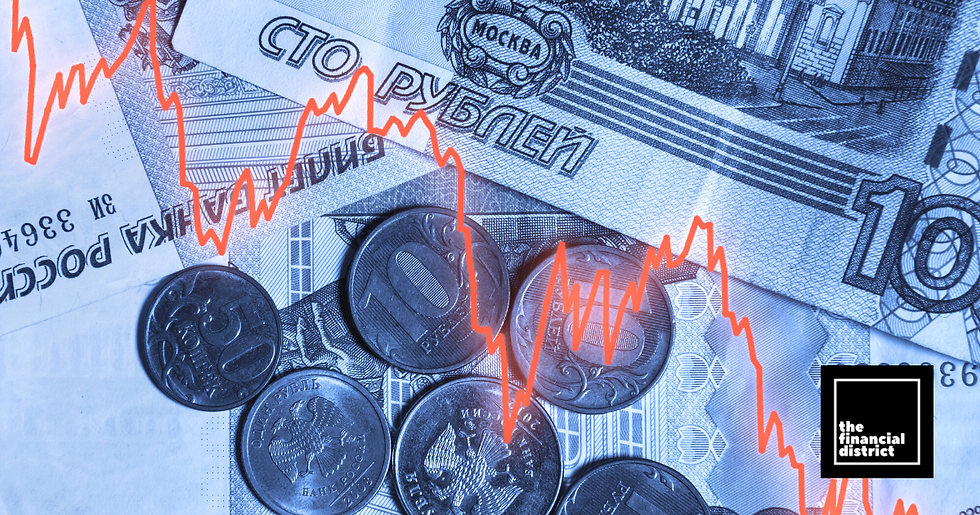
Photo Insert: The ruble has also risen amid reports that the Kremlin has been more open to cease-fire talks with Ukraine.


Russian President Vladimir Putin has resorted to extreme financial measures to blunt the West’s penalties and inflate his currency, Ken Sweet and Ellen Knickmeyer reported for the Associated Press (AP).
While the West has imposed unprecedented levels of sanctions against the Russian economy, Russia’s Central Bank has jacked up interest rates to 20% and the Kremlin has imposed strict capital controls on those wishing to exchange their rubles for dollars or euros. It’s a monetary defense Putin may not be able to sustain as long-term sanctions weigh down the Russian economy.

“The US has already banned imports of Russian oil and natural gas, and the UK will phase them out by the end of this year. However, these decisions will not have a meaningful impact unless and until the EU follows suit,” wrote Benjamin Hilgenstock and Elina Ribakova, economists with the Institute of International Finance, in a report released Wednesday.
Hilgenstock and Ribakova estimate that if the EU, Britain and the US were to ban Russian oil and gas, the Russian economy could contract more than 20% this year. That’s compared with projections for up to a 15% contraction, as sanctions stand now.

The ruble was trading at roughly 85 to the US dollar, roughly where it was before Russia started its invasion a month ago. The ruble had fallen as low as roughly 150 to the dollar on March 7, when news emerged that the Biden administration would ban US imports of Russian oil and gas. Speaking to Norway’s parliament on Wednesday, Ukraine’s president urged Western allies to inflict still greater financial pain on Russia.
"The only means of urging Russia to look for peace are sanctions,” Volodymyr Zelenskyy said in a video message from his besieged country. He added: “The stronger the sanctions packages are going to be, the faster we’ll bring back peace.” Increasingly, European nations’ purchases of Russian oil and natural gas are coming under scrutiny as a loophole and lifeline for the Russian economy.

“For Russia, everything is about their energy revenues. It’s half their federal budget. It’s the thing that props up Putin’s regime and the war,” said Tania Babina, an economist at Columbia University who was born in Ukraine.
Babina is currently working with a group of 200 Ukrainian economists to more accurately document how effective the West’s sanctions are in stymying Putin’s war-making capabilities.

The ruble has also risen amid reports that the Kremlin has been more open to cease-fire talks with Ukraine. US and Western officials have expressed skepticism about Russia’s announcement that it would dial back operations.