%20(3).png)


![TFD [LOGO] (10).png](https://static.wixstatic.com/media/bea252_c1775b2fb69c4411abe5f0d27e15b130~mv2.png/v1/crop/x_150,y_143,w_1221,h_1193/fill/w_179,h_176,al_c,q_85,usm_0.66_1.00_0.01,enc_avif,quality_auto/TFD%20%5BLOGO%5D%20(10).png)
Russia To Upend Energy Market, Punish European Economies
- By The Financial District

- Feb 25, 2022
- 2 min read
Some commentators are comparing the current Russian aggression against Ukraine to Hitler’s invasion of Poland in August 1939. Here’s another analogy that could be more accurate: In 1979, upheavals in the Middle East sent energy prices soaring—and Western economies tumbling, David Frum reported for The Atlantic.
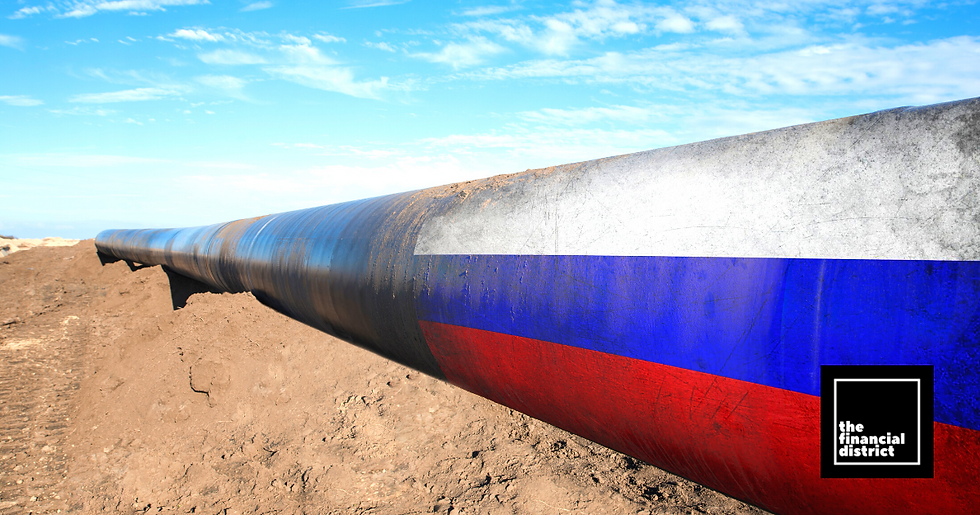
Photo Insert: Russia is the world’s No. 3 exporter of oil, and its No. 2 exporter of natural gas. If Western countries respond to Russia’s invasion by imposing sanctions, Russia’s obvious countermove is to retaliate by cutting back fuel sales.


Russia is the world’s No. 3 exporter of oil, and its No. 2 exporter of natural gas. If Western countries respond to Russia’s invasion by imposing sanctions, Russia’s obvious countermove is to retaliate by cutting back fuel sales. Such a move would hurt Russia too.
But Vladimir Putin has carefully prepared for the shock—and of course, Russian citizens have learned that it’s dangerous to complain. The state of the energy market provides much of the answer to the “Why now?” questions about Putin’s timing.

Donald Trump supporters like to argue that it was their guy’s manic unpredictability that deterred Putin from invading in 2018 or 2019. That claim was smashed to pieces yesterday when Trump praised the invasion as “genius” and “savvy.”
The real explanation for Putin’s timing is the slackness of the world energy market in the late 2010s—and its new tightness in the 2020s. From mid-2014 until the onset of the global pandemic in 2020, Russian gas sold for less than $10 per million metric British thermal units, often for under $5. But the gas market is inescapably cyclical.

The low prices of the 2010s discouraged investment in new supply, setting the conditions for higher prices in the 2020s. As the world economy began to recover from the early pandemic, so did the price of gas. The price of Russian gas on spot markets surpassed $10 per million metric BTUs in June 2021, then $15, then $20; it’s now about $30.
The higher prices enabled Russia to build massive holdings of dollars, euros, and gold. Those holdings now exceed $630 billion, an impressive stash for a country with a GDP of only $1.5 trillion.

In 2017, 2018, and 2019, Russia’s dominance over its gas customers in Western Europe was weaker, and its financial resources to endure market disruption were fewer. In 2022, Russia’s power over its gas customers is at a zenith—and its financial resources are enormous.
Putin has been building to this crisis for a long time, and Trump’s contempt for NATO and hostility to European allies were exactly the help Putin required at the time he required it. Now we have arrived at an impasse where Russia could inflict real havoc on world energy markets, if it chooses.