%20(3).png)


![TFD [LOGO] (10).png](https://static.wixstatic.com/media/bea252_c1775b2fb69c4411abe5f0d27e15b130~mv2.png/v1/crop/x_150,y_143,w_1221,h_1193/fill/w_179,h_176,al_c,q_85,usm_0.66_1.00_0.01,enc_avif,quality_auto/TFD%20%5BLOGO%5D%20(10).png)
Trump's China Deal A Flop As Beijing Buys Zero U.S. Goods
- By The Financial District

- Feb 17, 2022
- 2 min read
Two years ago, President Donald Trump signed what he called a "historical trade deal" with China that committed China to purchase $200 billion of additional US exports before December 31, 2021, Chad P. Brown of the Peterson Institute for International Economics (PIIE) said in an analysis.
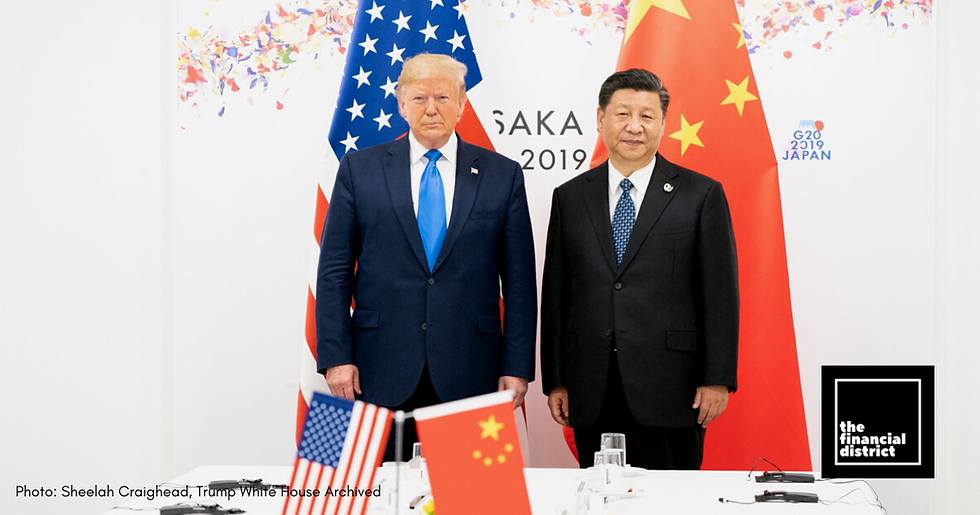
Photo Insert: Former President Donald J. Trump and Xi Jinping, President of the People’s Republic of China, during their bilateral meeting at the G20 Japan Summit in Osaka, Japan


Today the only undisputed "historical" aspect of that agreement is its failure. One lesson is not to make deals that cannot be fulfilled when unforeseen events inevitably occur—in this case, a pandemic and a recession. Another is not to forget the complementary policies needed to give an agreement a chance to succeed, Brown argued.
In the end, China bought only 57 percent of the US exports it had committed to purchase under the agreement, not even enough to reach its import levels from before the trade war.

Put differently, China bought none of the additional $200 billion of exports Trump's deal had promised.
Trump's "phase one" agreement with his "very, very good friend" President Xi Jinping was not a total washout. The deal did halt his spiraling trade war. And several of its elements should be kept, notably China's commitments to remove technical barriers to US farm exports, respect intellectual property, and open up its financial services sector.

However, signing something that was problematic, if not unrealistic, from the start, shows some degree of bad faith on both sides. After two years of escalating tariffs and rhetoric about economic decoupling, the deal did little to reduce the uncertainty discouraging the business investment needed to restart US exports.
Most of Trump's tariffs remained in effect, especially on inputs, raising costs to US companies. And by failing to negotiate the removal of China's retaliatory tariffs, the agreement may have funneled any Chinese demand for US exports away from China's private sector toward its state-owned enterprises.

The emergence of the COVID-19 pandemic undermined any chance of success. Public health-related lockdowns and a short economic recession were accompanied by a temporary collapse in goods trade globally, even if China's imports were mostly spared. Restrictions on mobility also decimated US services exports like tourism and business travel.