%20(3).png)


![TFD [LOGO] (10).png](https://static.wixstatic.com/media/bea252_c1775b2fb69c4411abe5f0d27e15b130~mv2.png/v1/crop/x_150,y_143,w_1221,h_1193/fill/w_179,h_176,al_c,q_85,usm_0.66_1.00_0.01,enc_avif,quality_auto/TFD%20%5BLOGO%5D%20(10).png)
Xi Jinping Wants None Of Rows Over History That Nearly Killed His Dad
- By The Financial District

- Dec 21, 2021
- 2 min read
Updated: Dec 23, 2021
Chinese President Xi Jinping is the son of a revolutionary whose life was more shaped by the danger of competing narratives about party history than perhaps anyone else in his generation.

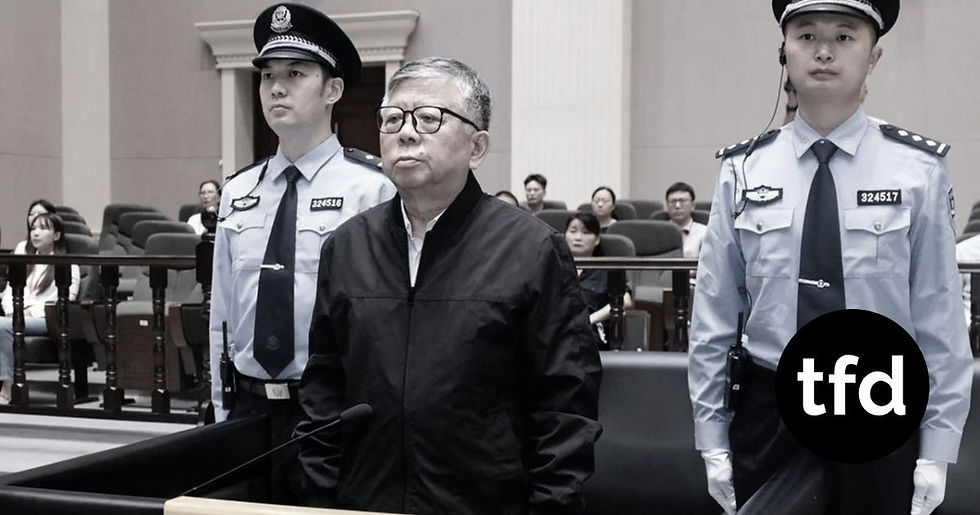
Photo Insert: Xi uniquely understands why historical grudges and differing views about the past are so potentially explosive.


Xi’s father, Xi Zhongxun, was persecuted for 16 years because of his support for a novel about party history, Joseph Torigian reported for Foreign Policy recently.
Now, his son has led the Chinese Communist Party (CCP) to a new “historical decision”—only the third in its 100-year history—and one in which Xi junior is an extraordinarily prominent figure.

A new history resolution allows Xi to implicitly compare himself to illustrious predecessors such as Mao and Deng Xiaoping and present the CCP as a historic force uniquely capable of modernizing China. But the actual content of the document prioritizes continuity, treats several controversial subjects vaguely, and avoids assigning blame.
Although the resolution acknowledges an accumulation of problems during his predecessors’ eras that only Xi is allegedly capable of solving, the Cultural Revolution is still characterized as a mistake and Reform and Opening Up a triumph. Xi uniquely understands why historical grudges and differing views about the past are so potentially explosive.

Xi Zhongxun was from the northwest, where the local CCP movement was far distant from the Central Soviet, the party’s core leadership, in the southern provinces of Jiangxi and Fujian. The Long March of 1934-35 would eventually bring the central party leadership to Shaanxi, but before that Xi and other Communists from the northwest went through vicious factional infighting that left behind mutual antagonisms that lasted decades.
Personal and party histories became deeply intertwined, and the battles of the 1930s would shape CCP politics for decades.

Wang Xiaozhong, who worked for the Central Advisory Council in the 1980s and helped manage those continuing debates over what happened 50 years earlier, wrote in his memoirs: “The scars left behind by brutal killings within the revolutionary units left a deep mark on their hearts forever, hurting them for their whole lives. … In party history propaganda, such a major historical event as the Northwest Issue was played down, skirted around, treated casually. As for the internal turmoil and butchery that are unbearable to look back on, they were simply not brought up.”