%20(3).png)


![TFD [LOGO] (10).png](https://static.wixstatic.com/media/bea252_c1775b2fb69c4411abe5f0d27e15b130~mv2.png/v1/crop/x_150,y_143,w_1221,h_1193/fill/w_179,h_176,al_c,q_85,usm_0.66_1.00_0.01,enc_avif,quality_auto/TFD%20%5BLOGO%5D%20(10).png)
Loretta Lynn, Country Music Icon And Rights Activist, Dies At 90
- By The Financial District

- Oct 5, 2022
- 2 min read
Loretta Lynn, the country singer whose plucky songs and inspiring life story made her one of the most beloved American musical performers of her generation, died on Tuesday at her home in Hurricane Mills, Tenn. She was 90.
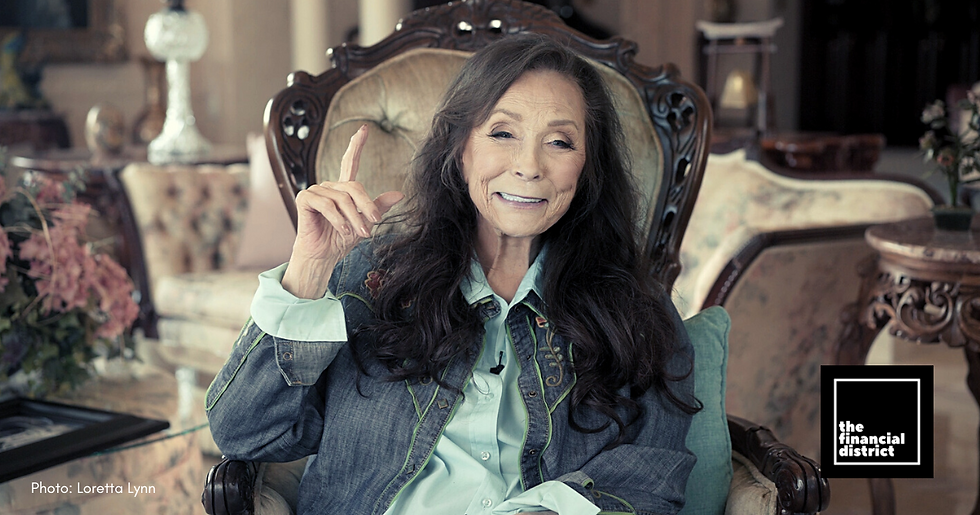
Photo Insert: Ms. Lynn built her stardom not only on her music, but also on her image as a symbol of rural pride and determination.


Her family, in a statement, said she died in her sleep, Bill Friskics-Warren reported for the New York Times.
Ms. Lynn built her stardom not only on her music, but also on her image as a symbol of rural pride and determination. Her story was carved out of Kentucky coal country, from hardscrabble beginnings in Butcher Hollow (which her songs made famous as Butcher Holler).

She became a wife at 15, a mother at 16, and a grandmother in her early 30s, married to a womanizing sometime bootlegger who managed her to stardom. That story made her autobiography, “Coal Miner’s Daughter,” a best seller and the grist for an Oscar-winning movie adaptation of the same name.
She drew much of her material from her marriage to Oliver Vanetta Lynn Jr., who was also known as Doolittle, Doo or Mooney, the last of these nicknames a nod to his practice of selling bootleg whiskey.

Ms. Lynn’s 1966 hit “You Ain’t Woman Enough (to Take My Man)” was based on a confrontation she had with one of her husband’s mistresses; her 1968 single “Fist City” was born of a similar incident.
The inspiration for “Don’t Come Home A-Drinkin’ (With Lovin’ on Your Mind),” in 1966, were those times when Mr. Lynn, his libido roused after a night out, would stumble home expecting to satisfy it. Lynn’s friendship with Patsy Cline emboldened her to assert her rights.

“Doo would always try to figure out which line was for him, and 90 percent of the time every line in there was for him,” Ms. Lynn told the weekly Nashville Scene in 2000. “Those songs was true to life. We fought hard, and we loved hard.”
The marriage lasted 48 years, until Mr. Lynn died of congestive heart failure in 1996. was unmistakable, with its Kentucky drawl, its tensely coiled vibrato and its deep reserves of power.

“She’s louder than most, and she’s gonna sing higher than you think she will,” said John Carter Cash, who produced Ms. Lynn’s final recordings. “With Loretta you just turn on the mic, stand back and hold on.”
Ms. Lynn placed 77 singles on the country charts. More than 50 of them reached the Top 10, and 16 reached No. 1, including “After the Fire Is Gone,” the first in a series of steamy hit duets she made with Conway Twitty.

Virtually all of her recordings were steeped in traditional country arrangements suited to Ms. Lynn’s perky backwoods drawl; most were produced by Owen Bradley, who likened her to “a female Hank Williams.”