%20(3).png)


![TFD [LOGO] (10).png](https://static.wixstatic.com/media/bea252_c1775b2fb69c4411abe5f0d27e15b130~mv2.png/v1/crop/x_150,y_143,w_1221,h_1193/fill/w_179,h_176,al_c,q_85,usm_0.66_1.00_0.01,enc_avif,quality_auto/TFD%20%5BLOGO%5D%20(10).png)
Molecule Boosts Bacteria-Eating Immune Cells To Treat Pneumonia
- By The Financial District

- Nov 18, 2021
- 2 min read
Pneumonia is usually treated with antibiotics, but unfortunately, these drugs are becoming less useful as bacteria develop resistance to them.
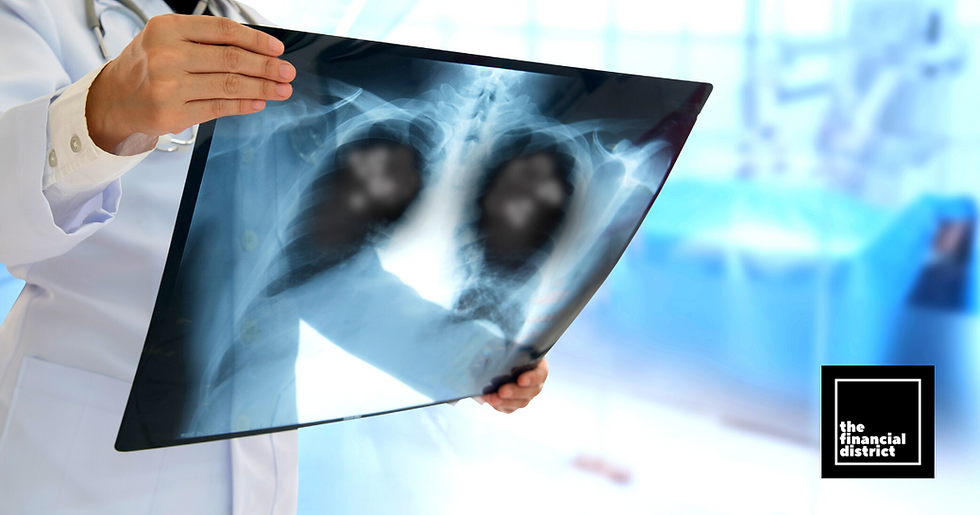
Photo Insert: An x-ray of a pneumonia patient


Now, researchers at the National Institutes of Health (NIH) have found a way to boost immune cells to eat the bacteria more effectively, potentially leading to a new pneumonia treatment.
Decades of overuse of antibiotics has led many species of bacteria to develop resistance to the drugs. Our last line of defense is beginning to fail and we might be on the cusp of a health crisis that could claim up to 10 million lives per year by 2050.

New antibiotics can help slow it down, but alternatives are desperately needed, Michael Irving reported for New Atlas. The study was published in the Journal of Clinical Investigation.
One such alternative is to target the host’s immune system and give it a helping hand in the fight against the invaders. For the study, the researchers looked at the complex interplay between immune cells called macrophages, inflammation, and bacteria. Macrophages patrol the body for things that shouldn’t be there, engulfing and destroying dangers like bacteria.

They’re summoned to sites of inflammation by other immune cells and can increase it if they need more assistance. But of course, inflammation can be a bad thing too, damaging tissue and causing pain if it goes on too long.
Compounds called epoxyeicosatrienoic acids (EETs) perform a regulatory function by limiting inflammation. However, EETs are suppressed during infections to allow the inflammation and immune cells to kill the invaders. So, for the new study, the researchers blocked EETs even further, using a synthetic molecule called EEZE.

The team tested the molecule in mice infected with Streptococcus pneumoniae, a bacteria that commonly causes pneumonia. And sure enough, the mice that received doses of EEZE had far reduced numbers of bacteria in the lungs than control mice.
Follow-up tests were conducted in human cells in the lab. The researchers harvested macrophages from lung and blood samples and placed them in test tubes with bacteria. Those that were also given EEZE killed more of the bacteria than those without.