%20(3).png)


![TFD [LOGO] (10).png](https://static.wixstatic.com/media/bea252_c1775b2fb69c4411abe5f0d27e15b130~mv2.png/v1/crop/x_150,y_143,w_1221,h_1193/fill/w_179,h_176,al_c,q_85,usm_0.66_1.00_0.01,enc_avif,quality_auto/TFD%20%5BLOGO%5D%20(10).png)
No Economic Expert In China Politburo's Standing Committee
- By The Financial District

- Oct 28, 2022
- 2 min read
Chinese President Xi Jinping ran the tables at the 20th National Congress of the Chinese Communist Party (CCP) last week, purging the final remnants of the once-strong Communist Youth League faction, publicly humiliating his predecessor, Hu Jintao, and seeing his role further enshrined in the Chinese Constitution, James Palmer wrote for Foreign Policy.
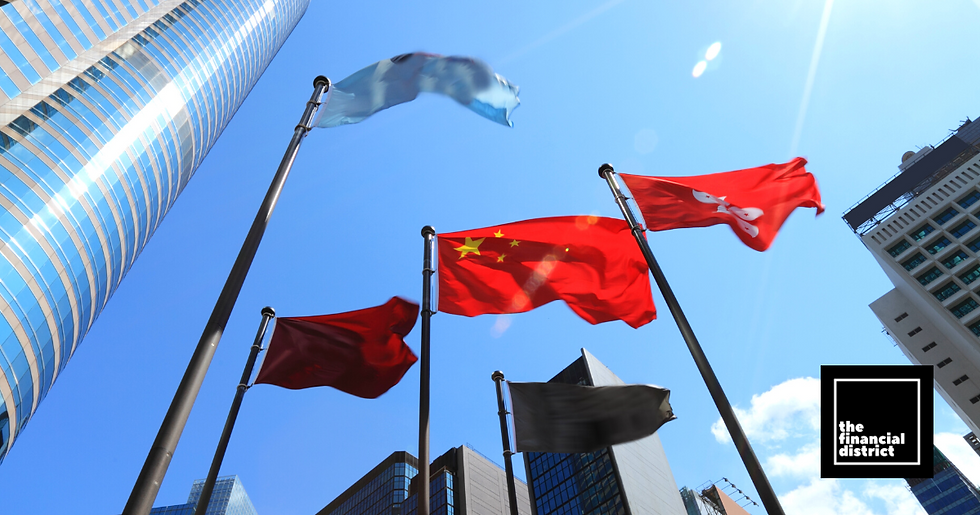
Photo Insert: In Xi’s personnel list, there are no signs of seeking to balance factions or throw bones to business or economic reformers.


Likewise, the new Standing Committee—which is comprised of the party’s seven most important leaders and includes Xi himself—is dominated by figures close to the president.
In Xi’s personnel list, there are no signs of seeking to balance factions or throw bones to business or economic reformers. Two serious contenders for the Standing Committee, Hu Chunhua, and Wang Yang—both known for being relatively pro-reform with a record of experimentation—were excluded from power altogether.

Wang, who served on the previous Standing Committee, didn’t even make it onto the Central Committee list of more than 200 officials whereas Hu was excluded from the 25-person Politburo.
Respected China institute MacroPolo surveyed more than 1,000 China experts, and not one called all seven names that ended up on the Standing Committee, reflecting how difficult political forecasting can be inside a closed system.

As it is, the leaders already on the Standing Committee have a lot in common. Most obviously, they’re all Han Chinese men in their 60s. A woman has never sat on the Standing Committee.
The age of the men on the new Standing Committee is also significant. The youngest, Ding Xuexiang, 60, is nine years younger than Xi—making him barely plausible as a candidate for leadership in the highly unlikely event that Xi retires in five years.

The rest of the group is so close to Xi’s age that they certainly couldn’t replace him. When Xi and former Chinese Premier Li Keqiang were added to the Standing Committee in 2007 at ages 54 and 52, respectively, they were held up as shining examples of youthful leadership.
Furthermore, none of the six new members also have the kind of family connections that Xi had or any strong regional or factional power base of their own, with the partial exception of Wang Huning, who is a nationalist theorist who was close with previous leaders.

That supports author Victor Shih’s thesis in his recent book “Coalitions of the Weak”: that strong leaders, such as former leader Mao Zedong, deliberately include politically weak underlings to reduce the chance of a political challenge.


