%20(3).png)


![TFD [LOGO] (10).png](https://static.wixstatic.com/media/bea252_c1775b2fb69c4411abe5f0d27e15b130~mv2.png/v1/crop/x_150,y_143,w_1221,h_1193/fill/w_179,h_176,al_c,q_85,usm_0.66_1.00_0.01,enc_avif,quality_auto/TFD%20%5BLOGO%5D%20(10).png)
Russia Burns Gas Worth Millions Daily, Ruins Baltic Ecology
- By The Financial District

- Aug 28, 2022
- 2 min read
Russia is burning an estimated $10 million worth of natural gas a day near its border with Finland, analysts say, even as it threatens to push Europe into a winter energy crisis by restricting exports to Germany and other countries, Anna Cooban, Nadine Schmidt and Mark Thompson reported for CNN Business.
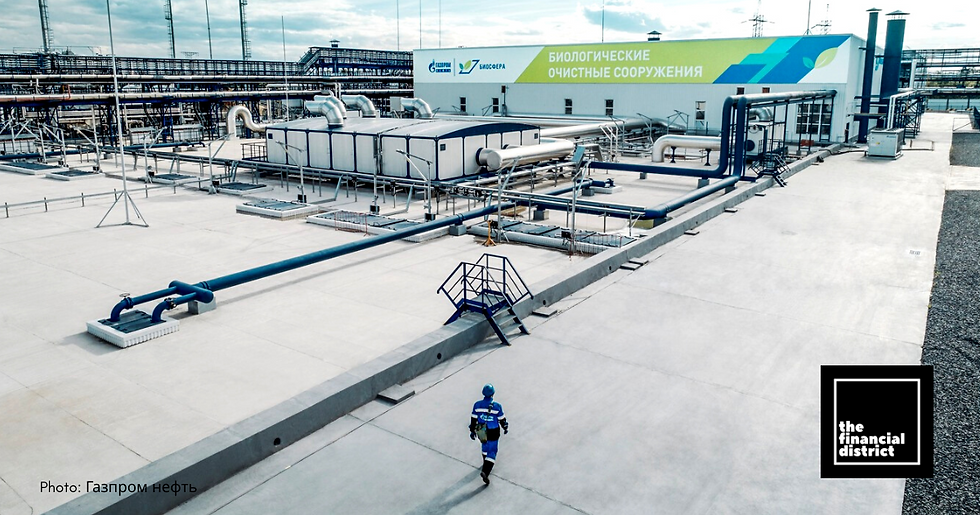
Photo Insert: State gas giant Gazprom is burning off, or "flaring," about 4.34 million cubic meters of gas a day at a new liquified natural gas (LNG) facility.


State gas giant Gazprom is burning off, or "flaring," about 4.34 million cubic meters of gas a day at a new liquified natural gas (LNG) facility, according to an analysis of heat levels and satellite data by Rystad Energy.
That's equivalent to 1.6 billion cubic meters on an annual basis, or about 0.5% of the bloc's gas demand, and worth about $10 million a day based on last week's European spot gas price. The Rystad analysis was first reported by the BBC on Friday.

The flaring at Gazprom's Portovaya plant is an "environmental disaster," Rystad said, with about 9,000 tons of carbon dioxide being emitted every day.
That's the same amount of emissions produced over a whole year by more than 1,100 average American homes. The plant is close to a compressor station at the beginning of the Nord Stream 1 pipeline, one of the main arteries carrying Russian gas to the European Union.

Rystad said that Russia is burning gas that would otherwise have been exported to Europe through the pipeline, which usually accounts for more than a third of Europe's gas imports but where flows have been throttled back to just 20% of normal levels.
Overall, gas exports to Europe from Russia are down 77% so far this year compared to the same period in 2021, according to Rystad. Last year, Moscow accounted for 45% of the European Union's total gas imports, data from the International Energy Agency shows.

The bloc has been trying to wean itself off Russian gas since the invasion of Ukraine six months ago. It is racing to fill up its storage facilities, cut its demand, and secure alternate energy sources to avoid having to ration energy this winter. In addition to the CO2 the flare is releasing into the atmosphere, it is also likely damaging the environment in other ways.
Mark Davis, CEO of Capterio, a firm advising energy companies on how to flare their gas, said that the practice is commonplace across Russia. "I think it's most likely an operational issue that operator Gazprom is struggling with," he told CNN Business.

One explanation could be the failure of equipment. Davis said that the flaring would likely be producing soot which is particularly destructive to the Arctic region. Much of the soot will end up on Arctic ice and absorb more heat from the sun, accelerating the melting of ice.
"Almost certainly, the flare is not operating with 100% efficiency, and so it's also emitting methane which is 80 times more potent as a greenhouse gas than carbon dioxide," Davis said.


