%20(3).png)


![TFD [LOGO] (10).png](https://static.wixstatic.com/media/bea252_c1775b2fb69c4411abe5f0d27e15b130~mv2.png/v1/crop/x_150,y_143,w_1221,h_1193/fill/w_179,h_176,al_c,q_85,usm_0.66_1.00_0.01,enc_avif,quality_auto/TFD%20%5BLOGO%5D%20(10).png)
Russia's Bloody Ukraine Invasion Punishes Global Economy
- By The Financial District

- Aug 22, 2022
- 2 min read
Martin Kopf needs natural gas to run his family’s company, Zinkpower GmbH, which rustproofs steel components in western Germany. Zinkpower’s facility outside Bonn uses gas to keep 600 tons of zinc worth 2.5 million euros ($2.5 million) in a molten state every day.
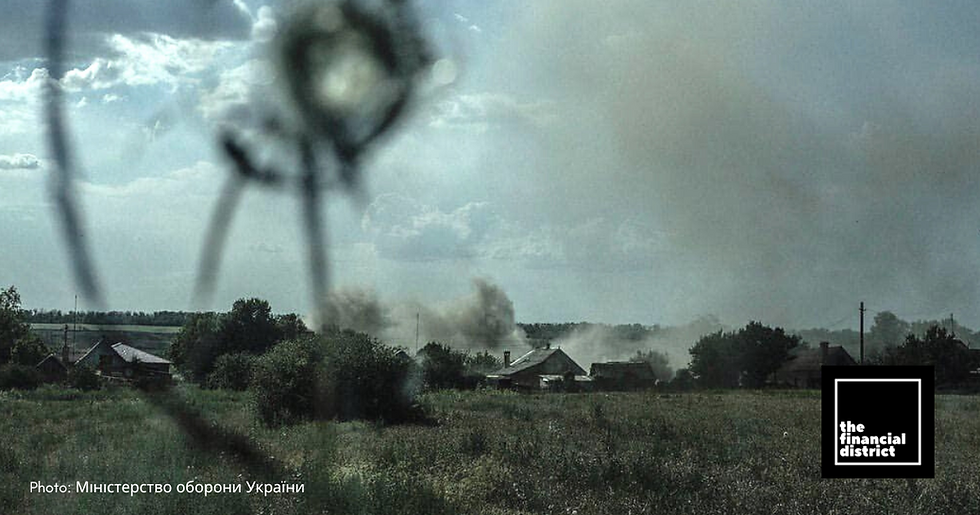
Photo Insert: Scenes of the Russian wrought devastation in Ukraine


The metal will harden otherwise, wrecking the tank where steel parts are dipped before they end up in car suspensions, buildings, solar panels, and wind turbines.
Six months after Russia invaded Ukraine, the consequences are posing a devastating threat to the global economy, including companies like Zinkpower, which employs 2,800 people, Paul Wiseman and David McHugh reported for the Associated Press (AP).

Outside Uganda’s capital of Kampala, Rachel Gamisha said Russia’s war in faraway Ukraine has hurt her grocery business. She has felt it in surging prices for necessities like gasoline, selling for $6.90 a gallon.
Something that’s 2,000 shillings (about $16.70) this week may cost 3,000 shillings ($25) next week. “You have to limit yourself,” she said. “You have to buy a few things that move fast.’’

Gamisha has noticed something else, too — a phenomenon called “shrinkflation”: A price may not change, but a doughnut that used to weigh 45 grams may now be only 35 grams. Bread that weighed 1 kilogram is now 850 grams.
Syahrul Yasin Limpo, Indonesia’s agriculture minister, warned this month that the price of instant noodles, a staple in the Southeast Asian nation, might triple because of inflated wheat prices.
In neighboring Malaysia, vegetable farmer Jimmy Tan laments that fertilizer prices are up 50%. He’s also paying more for supplies like plastic sheets, bags, and hoses.

In Karachi, Pakistan, far from the battlefields of Ukraine, Kamran Arif has taken a second, part-time job to supplement his wages. “Because we have no control on prices, we can only try to increase our income,” he said.
A vast majority of people live in poverty in Pakistan, whose currency has lost up to 30% of its value against the dollar and the government has increased electricity prices 50%.

Europe, which for years depended on Russian oil and natural gas for its industrial economy, has absorbed a gut punch. It faces the growing threat of recession as the Kremlin throttles back flows of natural gas used to heat homes, generate electricity and fire up factories.
Prices are 15 times what they were before Russia massed troops on the Ukrainian border in March 2021.

“There’s a lot more recessionary risk and pressure in Europe than in the rest of the high-income economies,” said Adam Posen, president of the Peterson Institute for International Economics (PIIE) and a former Bank of England policymaker. The damage has hardly spared Russia, whose economy the IMF expects to contract 6% this year.
Sergey Aleksashenko, a Russian economist now living in the US, noted that the country’s retail sales tumbled 10% in the second quarter compared with a year earlier as consumers cut back. “They have no money to spend,” he said.


