%20(3).png)


![TFD [LOGO] (10).png](https://static.wixstatic.com/media/bea252_c1775b2fb69c4411abe5f0d27e15b130~mv2.png/v1/crop/x_150,y_143,w_1221,h_1193/fill/w_179,h_176,al_c,q_85,usm_0.66_1.00_0.01,enc_avif,quality_auto/TFD%20%5BLOGO%5D%20(10).png)
Top Brewers Seek To Ramp Up Production Of Zero Alcohol Beer
- By The Financial District

- Jul 21, 2021
- 2 min read
While many drinkers may celebrate the easing of pandemic restrictions with a beer or glass of wine, the world's biggest brewers will be urging them to try new zero alcohol lagers, Philip Blenkinsop and Joyce Philippe wrote for Reuters.
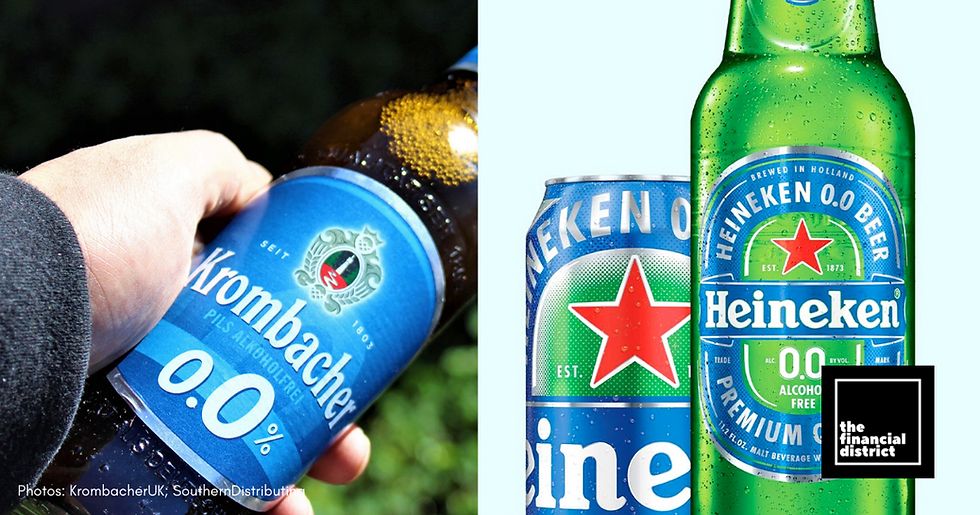

Having lost market share to craft beers and hard seltzers, or alcoholic fizzy water, top brewers like AB InBev and Heineken are betting on a new generation of non-alcoholic beers to help regain ground by tapping into the global healthy-living trend.
But the pandemic canceled business lunches, emptied sports facilities, and left no one driving back from parties or bars - all prime territories for sales of zero alcohol drinks. Global non-alcohol beer sales fell 4.6% in 2020 in value terms to $11.6 billion after 9% average annual growth in the previous four years, according to market research provider Euromonitor International.

The ending of restrictions in the United States and Europe is now making it easier for brewers to get drinkers to try out new zero alcohol versions of their top-selling brands - something they believe will be crucial to ramping up sales.
"The main barrier for consumers is expectations, as in that they do not expect it to taste good," said Borja Manso-Salinas, vice president for marketing of the Heineken brand in the United States.
At a sampling session at the Pier 17 concert and dining venue in lower Manhattan this month, Heineken broke that barrier for some passers-by, including Cary Heinz who brought over a regular Heineken from a nearby stand to compare. "I can't tell the difference. And I'm a real drinker," he said, with a can in each hand.
Previously, many zero beers were effectively cooked to evaporate alcohol, spoiling the taste. Brewers often now use a vacuum chamber so alcohol comes off at a lower temperature and sometimes seek to blend back escaped esters that are central to the flavor.
The world's second-largest brewer launched Heineken 0.0 in the United States in 2019 and planned to distribute 10 million free cans last year, but managed less than half that because of the pandemic. The Dutch brewer believes it is back on track in 2021, with around four million free samples going to offices alone. Other samples are bound for music festivals, apartment buildings, and shopping malls.

Anheuser-Busch InBev (AB InBev) (ABI.BR), the world's and the United States' largest brewer, also launched a zero version of its flagship Budweiser lager in the United States a year ago.
"Historically, one of the barriers to overcome is taste," said Todd Allen, global marketing vice president of the Budweiser brand. "It's really important for people to try the product." Europe represents almost three-quarters of non-alcoholic beer drunk, market research company insightSLICE says.
In Spain, zero alcohol beers make up 13% of all beer sales. In Japan, where nearly 5% of beer sales contain no alcohol, brewers are launching new brands and forecasting steep growth. However, the United States is almost virgin territory, with zero alcohol's market share just 0.5%, according to Euromonitor.