%20(3).png)


![TFD [LOGO] (10).png](https://static.wixstatic.com/media/bea252_c1775b2fb69c4411abe5f0d27e15b130~mv2.png/v1/crop/x_150,y_143,w_1221,h_1193/fill/w_179,h_176,al_c,q_85,usm_0.66_1.00_0.01,enc_avif,quality_auto/TFD%20%5BLOGO%5D%20(10).png)
U.S. Economy To Suffer As Demand For Fossil Fuel Shrinks
- By The Financial District

- Dec 8, 2021
- 2 min read
Since the 1990s, the United States has been marked by a conflicted position in global climate policy. It is easy to point the finger at the Republican Party or former US President Donald Trump’s crude climate denials.
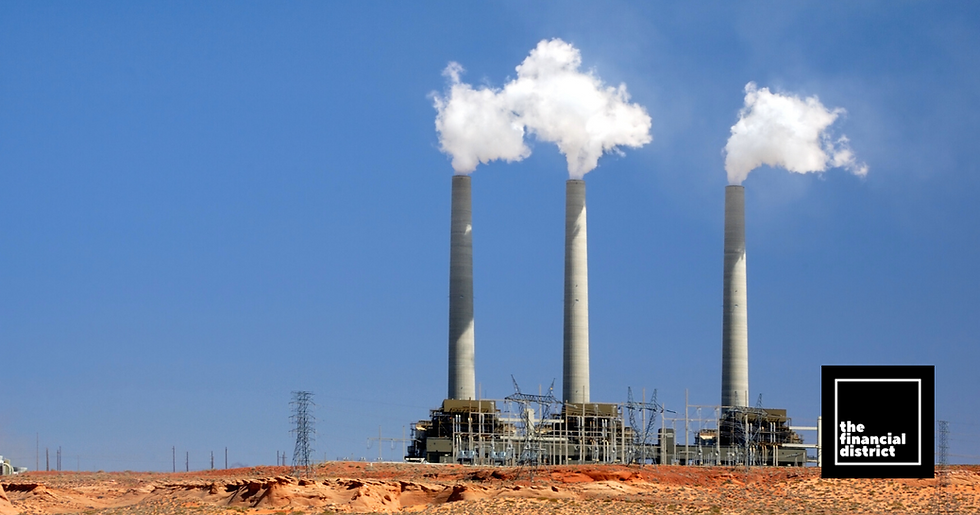
Photo Insert: A US coal plant


But it goes far deeper than that. From the start, the US’s huge energy consumption made it a target for those demanding immediate action to halt the climate crisis, Adam Tooze wrote in his column for Foreign Policy.
It was little wonder Congress resisted any climate agreement that did not enroll the rest of the world on equal footing—and thus rejected the 1997 Kyoto Protocol. Whatever the merits of climate justice arguments, they cut little ice with defenders of the US way of life.

US energy producers stand firm as a recalcitrant defensive lobby. US oil interests were among the leading sponsors of denial. Since the 1980 Carter Doctrine, US geopolitical power has focused on securing control of the Persian Gulf. It was not for nothing that in the early days of climate policy, the US featured as the great Satan.
Given this underlying balance of interests, the GOP’s position of denial at least has the merit of consistency. Given the US’ existential entanglement with fossil fuels, it is easier to strike a patriotic pose if you assume away the climate crisis or trust that technology will deliver the solution by itself.

It is Democrats who find themselves in a conflicted position, seeking to square the realities of America’s political economy with the climate threat’s urgency. The root of the incoherence lies in political economy: the US’ dual role as a huge consumer and producer of fossil fuels as well as the policeman of the world’s oil and gas supplies.
The Obama administration midwifed the Paris Agreement while, at the same time, permitting the increased export of US oil and gas. Trump was the first US president to actively deny the reality of the climate problem. For him, all that counted was the country’s “energy dominance” be secured by the export of US liquefied natural gas—or “molecules of US freedom.”

With President Joe Biden’s administration, cognitive dissonance returned. Biden supports climate leadership and made a constructive contribution to the Glasgow negotiations while licensing oil and gas development and goading OPEC into increasing its production.

One could simply denounce the hypocrisy, but that misses the point. The root of the incoherence lies in political economy: the US’ dual role as a huge consumer and producer of fossil fuels as well as the policeman of the world’s oil and gas supplies.


