%20(3).png)


![TFD [LOGO] (10).png](https://static.wixstatic.com/media/bea252_c1775b2fb69c4411abe5f0d27e15b130~mv2.png/v1/crop/x_150,y_143,w_1221,h_1193/fill/w_179,h_176,al_c,q_85,usm_0.66_1.00_0.01,enc_avif,quality_auto/TFD%20%5BLOGO%5D%20(10).png)
U.S Raising $200B To Fund G7 Plan vs China Belt And Road Scheme
- By The Financial District

- Jun 27, 2022
- 2 min read
The United States plans to raise $200 billion in private and public funding over five years to support essential infrastructure in developing nations as part of a G7 attempt to challenge China's multitrillion-dollar Belt and Road Initiative, according to Reuters' Andrea Shalal.
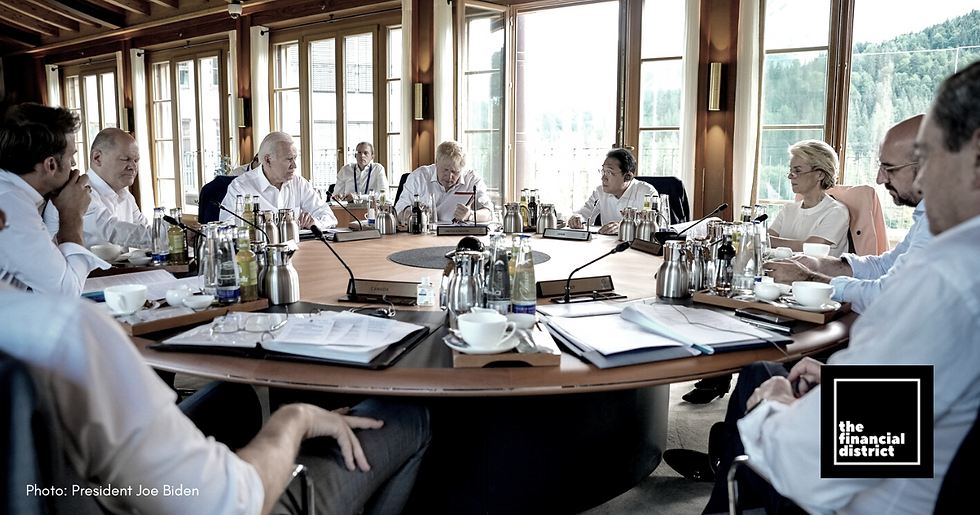
Photo Insert: Worried by China, G7 leaders first proposed the project last year and are now formally launching it under a new name, "Partnership for Global Infrastructure and Investment," discarding the slogan "Build Back Better World."


At this year's Group of Seven summit in Schloss Elmau, Germany, U.S. President Joe Biden will outline the ideas, flanked by other Group of Seven leaders, some of whom have previously announced their own independent projects. Worried by China, G7 leaders first proposed the project last year and are now formally launching it under a new name, "Partnership for Global Infrastructure and Investment," discarding the slogan "Build Back Better World."

At a G7 side event, President Biden will present several specific initiatives alongside leaders from the United Kingdom, Germany, Japan, the European Union, and Canada, committing to work on projects that help combat climate change as well as promote global health, gender equity, and digital infrastructure.
French President Emmanuel Macron, who had formally joined China's infrastructure program, will be conspicuously absent.

According to White House officials, Xi's goal to build a new version of the ancient Silk Road trade route has delivered little visible benefit to many developing countries, with top jobs going to Chinese employees while forced and child labor rates have increased.
“The President's not thinking that we need to spend dollar for dollar versus China ... though if you add up what the U.S. and the G7 partners are going to be announcing, it comes pretty close to the number," one senior U.S. official told reporters.

According to the White House, the funds would be raised through grants and federal funds, as well as through leveraging private-sector investments, with hundreds of billions of dollars coming from multilateral development banks, development financing institutions, sovereign wealth funds, and others.


