%20(3).png)


![TFD [LOGO] (10).png](https://static.wixstatic.com/media/bea252_c1775b2fb69c4411abe5f0d27e15b130~mv2.png/v1/crop/x_150,y_143,w_1221,h_1193/fill/w_179,h_176,al_c,q_85,usm_0.66_1.00_0.01,enc_avif,quality_auto/TFD%20%5BLOGO%5D%20(10).png)
Monday Circle Conversations
- By Gerry Urbina

- Apr 30
- 4 min read
Updated: May 1
The conversations at the Monday Circle rarely begin with theatrics. They unfold over coffee, breakfast, and a roomful of market-sensitive minds, including stockbrokers, investment bankers, corporate executives, seasoned journalists, and policy watchers who treat information as both signal and risk.


Held twice a month, the breakfast forum has quietly evolved into a space where political sentiment, economic direction, and governance narratives are tested before they reach broader public discourse.
Last Monday’s session was no exception. If anything, it felt like an early read on the country’s evolving political and policy landscape, anchored by two very different but equally consequential briefings. One came from Guido David of OCTA Research, and the other from Claire Castro of the Presidential Communications Office (PCO).
Dr. David took the floor first, while Undersecretary Castro quietly settled into her seat with breakfast.

The shift in tone was immediate. What began as a routine survey presentation turned into a broader conversation about momentum, uncertainty, and the mechanics of electoral behavior.
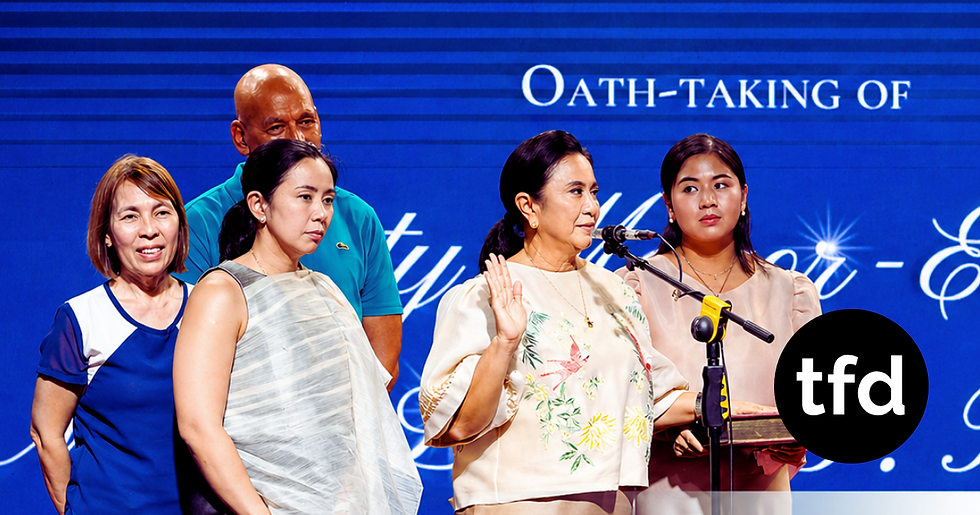
At the center of the discussion was a familiar name, Mayor Leni Robredo, whose numbers, according to the latest March fieldwork, are trending upward.
“Her performance is slowly going up,” David noted, framing the movement as momentum rather than dominance.
In a hypothetical head-to-head scenario, Robredo registers around 35 percent. It is a strong showing, but not yet decisive.
What makes the story more compelling is the context around those numbers. Roughly 19 percent of voters remain undecided.

“That’s a significant piece,” David emphasized. In market terms, it is unallocated capital that remains fluid, impressionable, and ultimately decisive. The implication is clear. The race is not locked and continues to take shape.
David was careful to temper any early conclusions. Philippine electoral history, he reminded the room, includes candidates who led early surveys but fell short on election day.
“Early survey leaders do not always translate into winners,” he said. Surveys, in his framing, are not forecasts. They are diagnostic tools that help explain direction, not destiny.
Other candidates, meanwhile, appear to be struggling to gain traction. “They are not registering high numbers… there’s no traction as of now,” he said, referring to figures who have yet to connect with voters.

The contrast underscored a key dynamic of the current cycle. Narrative strength appears to be outweighing mere visibility.
Even more telling was the case of Senator Raffy Tulfo, whose earlier polling strength faded after signaling he would not run. “When he declared he wasn’t running, his numbers went quiet,” David observed.
It was a reminder that voter support can be soft and dependent on perceived viability.
By the time David concluded, the room had absorbed a central thesis. This is a momentum election, not a foregone conclusion.

The “magic number” to win, he noted, remains around 40 percent, a threshold that no candidate has yet approached with certainty.
If David’s presentation mapped the political terrain, Castro’s briefing shifted the lens to governance under pressure.
Her message was anchored in one overriding concern, the unfolding crisis in the Middle East and its implications for energy security. “The President’s focus right now is ensuring continuous petroleum supply. Without supply, everything else stops,” she said, referring to Ferdinand “Bongbong” Marcos, Jr..
Inflation, she acknowledged, is inevitable. “There will definitely be inflation because of what is happening in the Middle East.” But the administration’s priority is clear. Availability comes before price control.

The framing was strategic. Energy in this context is not merely an economic variable. It has become a national security issue. Supply disruptions would ripple through logistics, mobility, and the broader economy.
The government’s posture, as Castro described it, is defensive but measured. Stabilize supply first, then manage the consequences.
From there, the discussion moved into governance and accountability, particularly around public works. Castro outlined the administration’s approach to investigating thousands of flood control projects from previous years.

“If not for the investigation, nothing would have surfaced. That is the job of the President,” she said. At the same time, she emphasized a broader distribution of responsibility.
“The President is not the one implementing on the ground. The responsibility lies with the agencies.”
The balancing act was evident. The administration positions itself as corrective while avoiding the concentration of blame at the executive level.
The conversation then turned to social welfare, where tensions were more pronounced. Financial assistance programs, or ayuda, remain politically necessary but economically contentious.

“We are studying up to what extent financial assistance should continue,” Castro said, acknowledging concerns raised by forum members about long-term dependency, which tends to promote a culture of mendicancy.
The issue compounded by fragmented beneficiary systems and operational inefficiencies in distributing financial aid.
There are growing fears amongst business leaders that what stabilizes households in the short term may create economic distortions over time particularly on industries that survive on entry-level employment.

Taken together, Castro’s briefing painted a picture of a government navigating competing pressures that include geopolitical risks, governance scrutiny, and socio-economic trade-offs.
The unifying thread is stability, both in maintaining it and in projecting it.
As the session wound down, an unspoken question lingered in the room.
Castro’s command of the issues, her composure under scrutiny, and her ability to translate policy into narrative did not go unnoticed. In a forum known for reading between the lines, the speculation felt almost inevitable.

Was this simply a policy briefing, or something more?
In the quiet calculus of the Monday Circle, where information often doubles as early signal, the thought emerged with increasing clarity. This may well be a prelude, not just to the next policy cycle, but to a possible 2028 Philippine Senate election bid.
For now, the numbers continue to move, the risks continue to evolve, and the narratives continue to form.
What last Monday’s conversation revealed is straightforward. Both politics and policy in the Philippines are entering a pre-electoral merge, where momentum, more than certainty, will shape the path forward.
--
ABOUT AUTHOR


